Where to buy
Carried by Amazon in every market, Barnes & Noble, Walmart, Waterstones, Booktopia, Kinokuniya, Flipkart, Google Books, Apple Books and Kobo. Printed on demand close to wherever it is ordered.
Listed with the worldwide trade network, so any bookstore or library can order it. Ask for it by ISBN: 978-1957456287 (hardcover).
What is inside
How can individuals, businesses, and governments respond to climate change in practical ways that help restore ecological balance and create a more sustainable future?
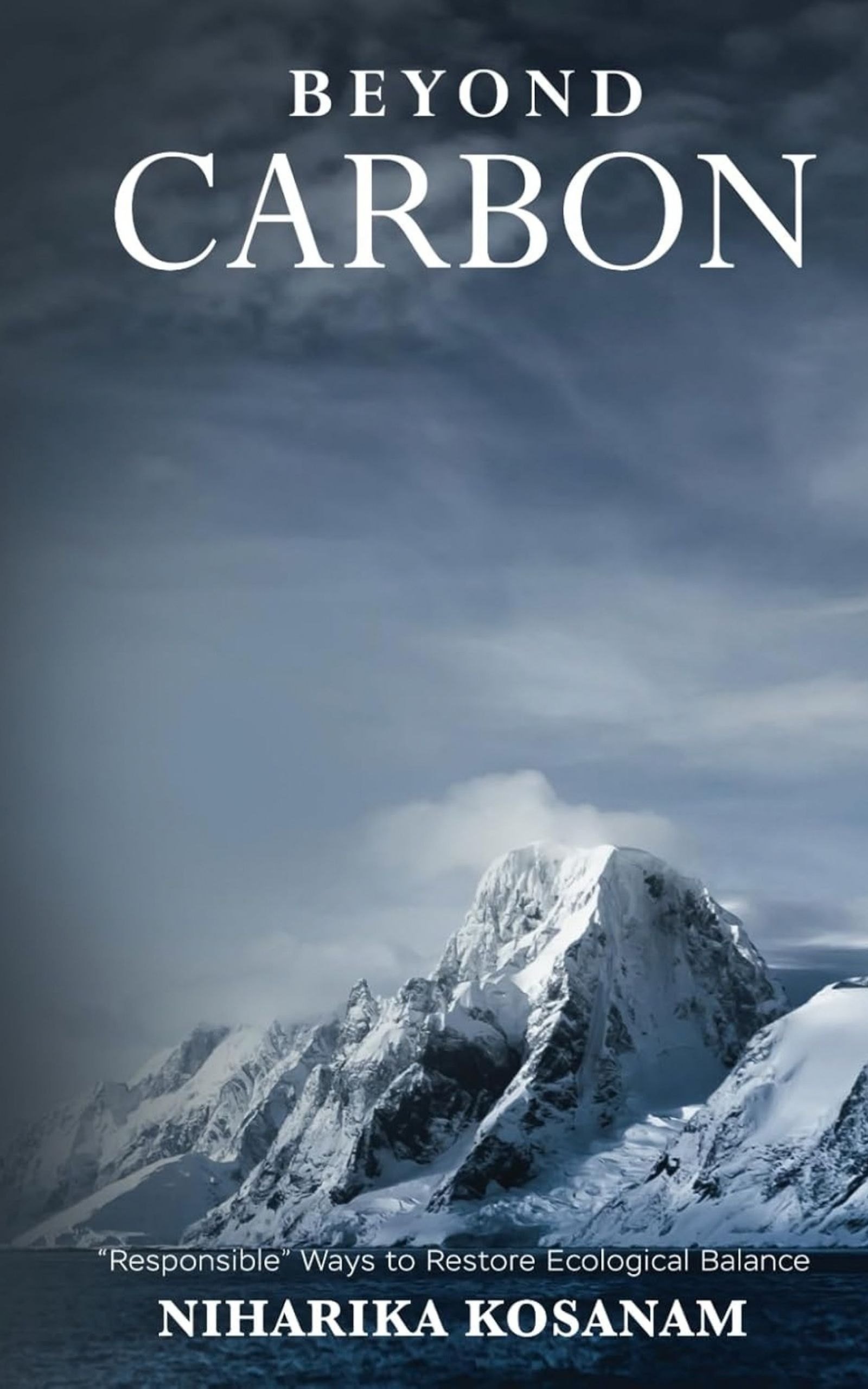
Beyond Carbon by Niharika Kosanam explores climate change not simply as an environmental problem, but as a challenge that directly affects the future of humanity.
Rather than framing sustainability only around “saving the planet,” the book encourages readers to recognise how human choices, systems, and lifestyles influence our own ability to thrive.
The book traces environmental concerns through the interconnected worlds of climate science, policy, business, construction, and personal responsibility. It explains how different stakeholders contribute to environmental impact and why meaningful change requires coordinated action rather than depending on a single solution.
Moving beyond conversations focused exclusively on carbon emissions, Niharika examines practical approaches to reducing environmental footprints and restoring balance between human development and natural ecosystems. The book encourages readers to reconsider consumption, resource use, design choices, business practices, and the broader systems that shape modern life.
Drawing on the author’s background in sustainable design and green building principles, Beyond Carbon also highlights the importance of creating environments and organisations that consider long-term ecological impact alongside economic and social needs.
At its core, the book asks readers to move from awareness to responsibility and recognise the role they can play in shaping a more resilient future.
Beyond Carbon is written for individuals interested in climate change and sustainable living, as well as architects, designers, developers, business leaders, policymakers, students, and sustainability professionals.
It is particularly relevant to readers seeking a broader understanding of ecological responsibility and practical ways to contribute to a more sustainable relationship between people, development, and the planet.
Excerpt
From “Title Page”
“We are the first generation to feel the sting of climate change, and we are the last generation that can do something about it.”
— Jay Inslee
A brief look at planet Earth's long and bewildering history reveals that change is the only constant. Climate change is a term often used to describe the changes in the Earth's atmosphere, which may cause changes in the geological, biological, geographical, and chemical components of the planet's systems. But the problem here is that the change is happening at an accelerated rate due to the consequences of our actions.
We have experienced the effects of climate change in our lifetimes - an increase in floods, droughts, degradation in the quality of fertile soil rise in epidemics and diseases are some of the many examples. However, to fully comprehend the impact of human activity on the climate and to figure out ways in which we can save our existence, we need to take a closer look at all the factors that can affect our planet's environment.
It is assumed that climate change refers to only the current alarming phenomenon of global warming, and its consequences can be short-sighted. The climate of Earth's atmosphere is constantly changing, sometimes due to external causes.
Most experts describe the atmosphere as a dynamic fluid, always in motion. This atmosphere is characterized by its physical properties, such as the rate and direction of its movement. These physical properties are, in turn, affected by several factors, such as solar radiation, the position of continents, the chemistry of the atmosphere, ocean currents, vegetation on the planet's surface, and the orientation of the mountain ranges (among other factors). Some of these influential factors change very rapidly.
The distribution of heat inside the ocean, the chemistry of the atmosphere, and surface vegetation can change at very short intervals. On the other hand, the position of continents, location, and height range of mountains change after long intervals of time. Thus, climate change will always be an ongoing process - affected by various physical properties.
Climate Fluctuation can be considered redundant since the climate is inherently dynamic, continuously undergoing change over the course of years, decades, centuries, or even millennia. Some areas have several years of drought, flooding, or other adverse weather conditions. Such decadal climate volatility complicates human activity and planning. Multiyear droughts, for example, can interrupt water supply, cause agricultural failures, and cause economic and social disruption.
About the author

Director, Continuum Studio · Texas, United States
Niharika Kosanam is the Founder of Continuum Studio, a LEED and IGBC Accredited Professional with expertise in building design, construction management, business development, sustainable design, and green building principles.
Published by Stardom Books — written from the author’s own words, in the author’s name. Browse the catalogue
Start here
The Authority Quotient is a thirty-minute evaluation that measures your authority two ways — how you rate yourself, and what a stranger can verify — and ends with one specific recommendation, including which type of book is yours.
Find your Authority QuotientNo cost. Get detailed report. Includes specific recommendations.