Where to buy
Carried by Amazon in every market, Barnes & Noble, Walmart, Waterstones, Booktopia, Kinokuniya, Flipkart, Google Books, Apple Books and Kobo. Printed on demand close to wherever it is ordered.
Listed with the worldwide trade network, so any bookstore or library can order it. Ask for it by ISBN: 978-1736948637 (paperback) or 978-1733211697 (hardcover).
What is inside
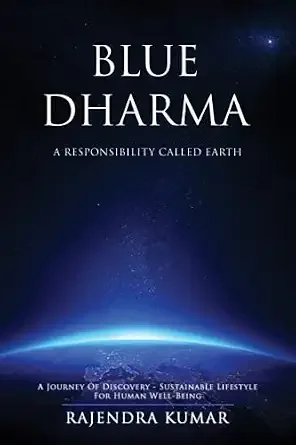
Blue Dharma explores this question through the real-world experience of creating a sustainable rurban community. Drawing from the challenges, observations, and lessons encountered during the project, Rajendra Kumar examines how counter-urbanization can offer an alternative approach to increasingly crowded and resource-intensive cities.
At the centre of the book are seven strands of sustainability: Air, Water, Soil, Food, Energy, Shelter, and People. Rather than considering these elements independently, the book explores how integrating them within a single living environment can contribute to human wellbeing while reducing pressure on natural resources.
The book also looks at the consequences of rapid urbanization, including increasing energy consumption, environmental degradation, reduced access to nature, changing food systems, and the gradual decline of community-oriented living. Through the concept of counter-urbanization, it considers how people can reconnect with natural systems while retaining the conveniences associated with contemporary life.
Alongside environmental sustainability, Blue Dharma examines the social and economic dimensions of development through the idea of a triple bottom-line business. The broader focus is on creating communities and lifestyles where people, nature, and economic activity can function together more responsibly.
At its core, the book presents sustainability not merely as an environmental concern, but as a shared responsibility that influences how we live, build, consume resources, and shape the world inherited by future generations.
This book is for sustainability advocates, entrepreneurs, architects, urban planners, developers, environmental professionals, students, policymakers, and readers interested in sustainable communities and responsible living. It is particularly relevant to those exploring climate-conscious development, rurban living, resource conservation, sustainable business, and practical ways of creating a closer relationship between human wellbeing and nature.
Excerpt
From “Title Page”
Counter-Urbanization
“We don't inherit the earth from our ancestors, we borrow it from our children.”
David Brower
Urbanization is undoubtedly one of the greatest achievements of humankind. Building and managing complex cities is impressive, and there has been significant progress over few decades on that front.
While this is a positive development in terms of human evolution, the same advancements have cluttered cities and created an imbalance in our ecosystem. This has made humans vulnerable, leading to an imbalance in every aspect of human wellbeing.
Our previous generation had an ample amount of time to spare. In fact, they spent time to save money. They led a more balanced life, free of or minimal stress and full of harmony.
Unfortunately, today, we are spending money to save time. We are all leading stressful lives. We are getting more and more isolated from community living.
In other words, the impact of urbanization on depleting human health and climate change is enormous. This urge to explore opportunities and save time made people explore living spaces closer to work, schools, and other city-life comforts.
Cities grew bigger and bigger each day, replacing trees with buildings and soil with concrete. As a result, buildings became the largest energy-consuming units globally, accounting for over one-third of the total final energy consumption.
It also became an equally important source of carbon-di-oxide (CO2) emissions. 70% of the global energy consumption is based on fossil fuels.
The rapid growth of the urban world and the equally ever-growing energy consumption have raised concerns over difficulties of meeting the demand leading to adverse environmental consequences by constant exhaustion of natural resources.
Every urban choice has consequences. The expansion of cities, growing land prices, reduced house sizes, and the density of concrete jungles have caused several damages. These choices have resulted in the depletion of groundwater, contamination of air, and adulteration in our food. Urbanization has also created a closed-door lifestyle.
This lifestyle has forced people to resort to air-conditioners in workspaces, cars, public transport, and even gyms. People no longer breathe fresh air, and this has drastically affected our immune system and our overall health. The enormous air pollution has depleted the ozone layer, exposing mankind to harmful radiation.
Rapid urbanization has also led the way to exclude every essential aspect of society that once contributed to a harmonious human existence.
About the author

Founder & MD, Crest Foundation · India
Rajendra Kumar is Founder & Managing Director of CREST Foundation and Co-Founder of Organo. His work focuses on sustainable living, rurban development, climate awareness, and creating communities that coexist with nature.
Published by Stardom Books — written from the author’s own words, in the author’s name. Browse the catalogue
Start here
The Authority Quotient is a thirty-minute evaluation that measures your authority two ways — how you rate yourself, and what a stranger can verify — and ends with one specific recommendation, including which type of book is yours.
Find your Authority QuotientNo cost. Get detailed report. Includes specific recommendations.