Where to buy
Carried by Amazon in every market, Barnes & Noble, Walmart, Waterstones, Booktopia, Kinokuniya, Flipkart, Google Books, Apple Books and Kobo. Printed on demand close to wherever it is ordered.
Listed with the worldwide trade network, so any bookstore or library can order it. Ask for it by ISBN: 978-1957456133 (paperback).
What is inside
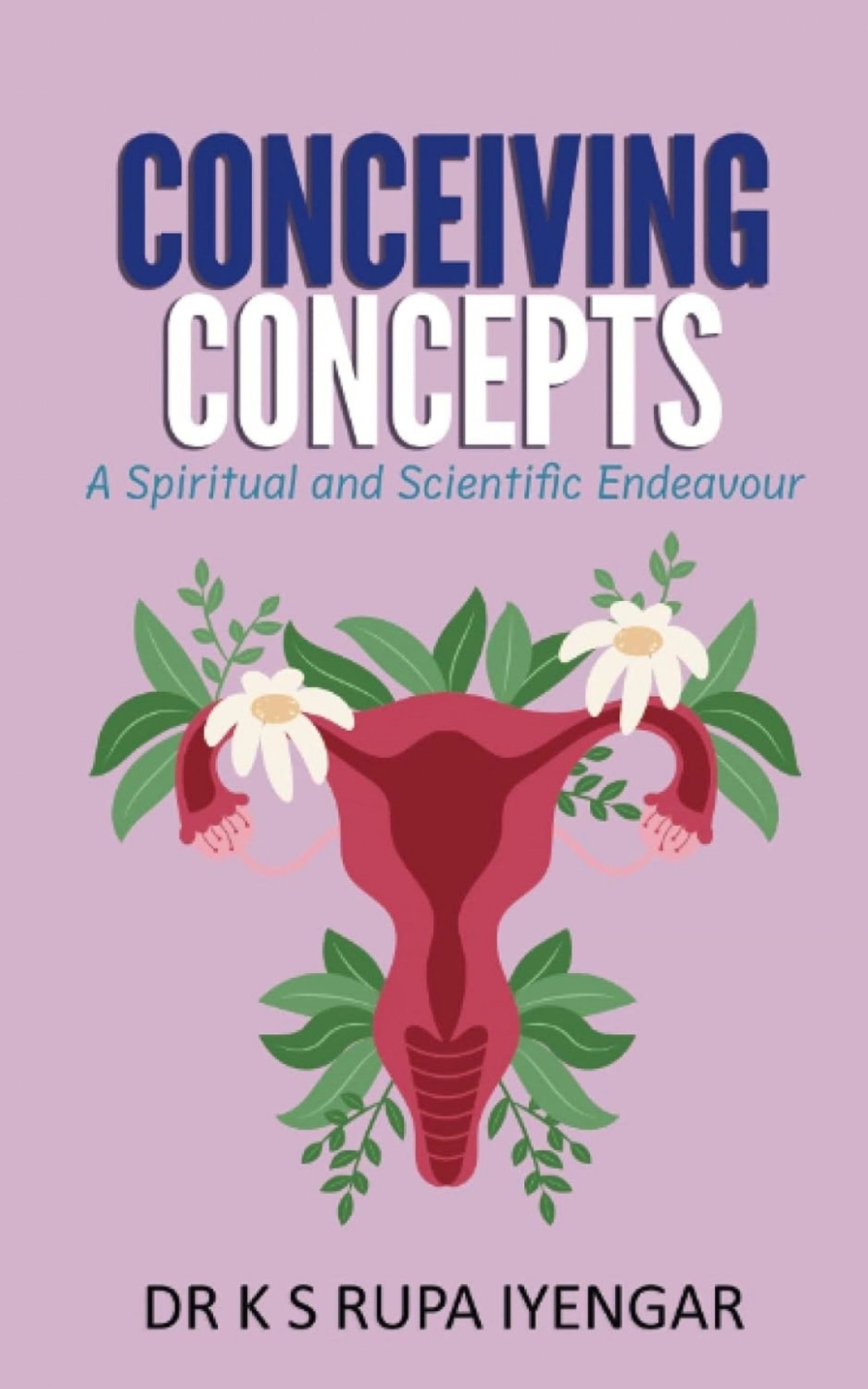
Conceiving Concepts by Dr. KS Rupa Iyengar explores fertility through two distinct lenses: science and spirituality. Drawing on her experience as a gynaecologist, obstetrician, and fertility specialist, Dr. Rupa explains the reproductive process and the factors that may contribute to difficulties in conceiving.
The book introduces readers to different fertility concerns and available treatment approaches, while emphasising that fertility treatment does not guarantee pregnancy. It aims to help readers understand the medical possibilities, limitations, and considerations involved in the journey towards parenthood.
Alongside the scientific perspective, the book discusses pregnancy through a spiritual framework involving concepts such as karma and samskaras. These ideas are presented as part of the author’s broader perspective on conception, encouraging readers to consider pregnancy beyond its biological dimensions.
By bringing these viewpoints together, Conceiving Concepts seeks to provide a more reflective understanding of fertility. It encourages aspiring parents to become better informed about reproductive health while also exploring the personal and spiritual meaning they may associate with conception and parenthood.
The book is written for individuals and couples planning a family, those experiencing fertility challenges, and readers seeking to understand fertility treatments and reproductive health.
It may also be useful for doctors, medical students, and allied health professionals interested in the author’s combined medical and spiritual perspective on conception, fertility, and pregnancy.
Excerpt
From “Title Page”
A woman is born with a finite number of eggs. The eggs undergo attrition in a programmed way unique to each person steadily, and when they are exhausted, the woman reaches menopause. The attrition of the eggs happens continuously irrespective of any situation, be it if the woman is pregnant, on contraception, or trying to conceive.
The loss of eggs by attrition is a process of apoptosis where the cells atrophy and die and disintegrate. Research is in progress to find out if there are stem cells in the ovary and if they can be activated to produce new eggs. Human females generate 7 million immature oocytes during foetal development; this number drops to 2 million by birth during follicle formation, a million of which appear intact.
By puberty, this number decreases to perhaps one hundred thousand, after which growth within follicles is countered by further attrition. Thus, there is an immense loss of oogonia and oocytes, beginning in the early foetus and continuing until menopause.
Oocytes develop from primordial germ cells that have migrated around the fourth embryonic week from the yolk sack to the gonadal ridge. Thus, most oocytes are not relevant to fertility, existing only within the ovary, never to be ovulated.
There is no clear idea of the purpose these oocytes serve and the reason why such a large number of oocytes undergo attrition. As the cessation of ovarian function (in humans, menopause, approximately around the ages of 45-51) approaches, the loss of oocytes accelerates until a threshold number of follicles remain that are incapable of maintaining the hormonal environment necessary for continuous ovarian cycling.
The follicles range from primordial follicles (0.03 mm), primary follicles (0.01-0.1mm), secondary follicles (0.1-0.2 mm), antral follicles (0.2-10 mm), dominant follicle (>10 mm), preovulatory follicles (18-20mm).
The hormone FSH acts only when the follicles reach the stage of antral follicles and the dominant and preovulatory follicles are FSH dependent. This is important because the period of 2-4 months before a follicle reaches an antral follicle state is a time where we can modify and take measures to improve oocyte quality.
The problem we face today is one of diminishing oocyte quality in younger as well as older women who are facing infertility issues.
Trailer
About the author

Founder & Medical Director, Dr Rupa's Reach Fertiity Clinic · Bangalore, India
Dr. KS Rupa Iyengar is a renowned gynaecologist and obstetrician who runs Dr. Rupa’s Reach Fertility Clinic. She shares her expertise in fertility care to guide aspiring parents, doctors, and medical students.
Published by Stardom Books — written from the author’s own words, in the author’s name. Browse the catalogue
Start here
The Authority Quotient is a thirty-minute evaluation that measures your authority two ways — how you rate yourself, and what a stranger can verify — and ends with one specific recommendation, including which type of book is yours.
Find your Authority QuotientNo cost. Get detailed report. Includes specific recommendations.