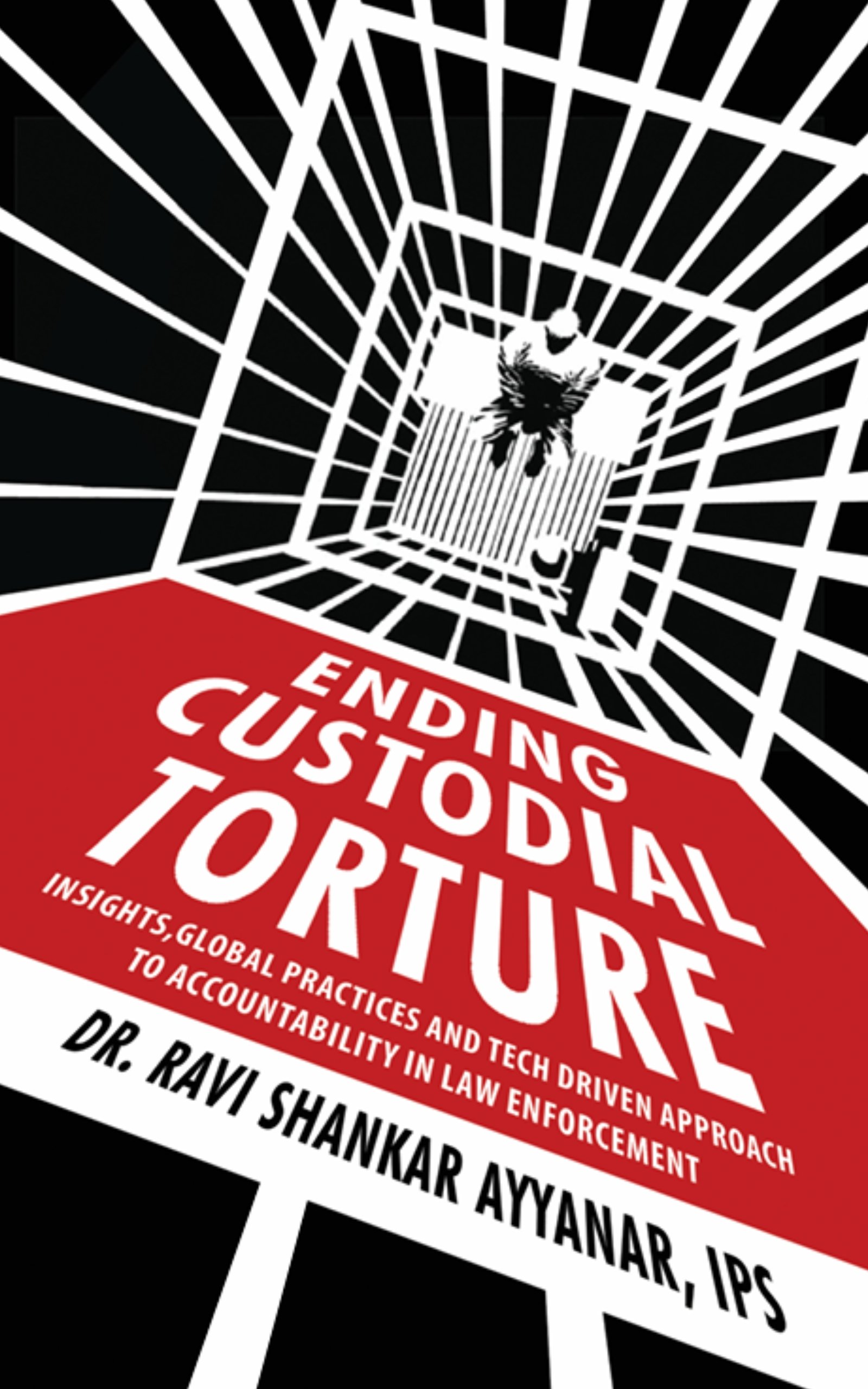
Where to buy
Carried by Amazon in every market, Barnes & Noble, Walmart, Waterstones, Booktopia, Kinokuniya, Flipkart, Google Books, Apple Books and Kobo. Printed on demand close to wherever it is ordered.
Listed with the worldwide trade network, so any bookstore or library can order it. Ask for it by ISBN: 978-1957456911 (paperback) or 978-1957456928 (hardcover).
What is inside
Can custodial deaths be prevented through stronger police management, evidence-based interventions, and institutional accountability? In Ending Custodial Torture, Dr. A. Ravi Shankar Ayyanar, IPS, examines this critical question through a combination of professional experience, academic research, and practical approaches to law enforcement.
Custodial deaths raise serious concerns about human rights, institutional responsibility, and public trust. Understanding why they occur requires looking beyond individual incidents to examine the organizational, legal, administrative, and human factors that contribute to custodial risk. The book explores documented incidents of custodial deaths, reviews existing research, and presents data analysis to identify patterns and underlying vulnerabilities.
It examines police management practices and human rights concerns while considering how institutional systems can be strengthened to prevent custodial harm. A central contribution is its proposed police management model, which introduces concepts such as the Vulnerability Index and Custody Quotient to support structured risk assessment. The book also considers the potential role of technology, monitoring, and periodic assessments in improving custodial management.
Drawing on his experience as a senior police officer, former medical doctor, and researcher, Dr. Ayyanar connects operational realities with academic findings. His work offers a framework for examining custodial safety through prevention, accountability, and responsible institutional practices.
Ending Custodial Torture is intended for police officers, law enforcement leaders, policymakers, legal professionals, human rights advocates, researchers, criminology students, and public administrators. It is also relevant to readers seeking a deeper understanding of custodial deaths and the challenges involved in preventing them.
The book contributes to an important conversation about how research, responsible leadership, and institutional reform can help build a justice system grounded in human dignity, transparency, and constitutional values.
Excerpt
From “1 Literature Review”
Every Custodial Death Raises a Question of Accountability
Custodial deaths refer to the deaths of individuals while they are in the custody of law enforcement or correctional authorities. Such incidents raise serious concerns about police brutality, institutional negligence, and the absence of accountability. While some deaths result from negligence or systemic shortcomings, others involve allegations of excessive force, torture, or the failure to provide timely medical assistance.
The following incidents illustrate the different circumstances in which custodial deaths can occur and the questions they raise about the responsibility of authorities.
The Telangana Encounter, 2019
On November 27, 2019, a woman veterinary doctor was sexually assaulted and murdered in Telangana’s Ranga Reddy district. Four suspects were subsequently arrested by the Hyderabad police.
On November 29, during a reconstruction of the crime scene, the police stated that the suspects had seized weapons, opened fire, and attempted to escape. Police personnel returned fire, resulting in the deaths of all four suspects.
The incident prompted sharply contrasting public reactions. While some welcomed the police action, others questioned whether the encounter represented justice or undermined the need for due process and accountability.
The Case of Mohammed Zakir
Mohammed Zakir, a 34-year-old auto driver, was arrested by Andhra Pradesh Police in July 2010 alongside four others for allegedly assisting Mohammed Viqaruddin, who was accused of killing police officers.
According to the account presented in the book, Zakir’s family remained unaware of his arrest for several months before discovering that he was being held in Cherlapally prison, Hyderabad.
On April 7, 2015, Zakir and four other undertrial prisoners were being transported from Warangal prison to a Hyderabad court when they were shot dead near Aler in Telangana’s Nalgonda district.
The Death of Nalluri Baburao
On February 18, 1990, Nalluri Baburao was arrested by Nagaram Police Station in Guntur district and placed in the lockup.
The following afternoon, a police constable on station watch duty discovered that Baburao had reportedly hanged himself using his lungi.
The case highlights a fundamental principle of custodial responsibility: once an individual is arrested, the police assume responsibility for that person's safety.
The Death of Uppulati Chandraiah
On March 8, 1990, Uppulati Chandraiah was brought to Husnabad Police Station in Karimnagar district and placed in custody.
The account describes how he was subsequently subjected to severe beating and torture by police personnel, leaving him with bleeding injuries. Despite his condition, he was returned to the police cell.
Chandraiah died in the lockup during the early hours of the following morning.
Together, these incidents illustrate the different circumstances surrounding deaths in custody and raise critical questions about custodial safety, police conduct, institutional responsibility, and accountability.
Trailer
About the author

IPS · Vishakhapatnam, India
Dr. A. Ravi Shankar Ayyanar, IPS, combines medical training with three decades of policing experience. A former UN peacekeeper & decorated officer, he researches custodial deaths & advocates ethical,accountable policing.
Published by Stardom Books — written from the author’s own words, in the author’s name. Browse the catalogue
Start here
The Authority Quotient is a thirty-minute evaluation that measures your authority two ways — how you rate yourself, and what a stranger can verify — and ends with one specific recommendation, including which type of book is yours.
Find your Authority QuotientNo cost. Get detailed report. Includes specific recommendations.