Where to buy
Carried by Amazon in every market, Barnes & Noble, Walmart, Waterstones, Booktopia, Kinokuniya, Flipkart, Google Books, Apple Books and Kobo. Printed on demand close to wherever it is ordered.
Listed with the worldwide trade network, so any bookstore or library can order it. Ask for it by ISBN: 979-8950206023 (paperback) or 979-8950206016 (hardcover).
What is inside
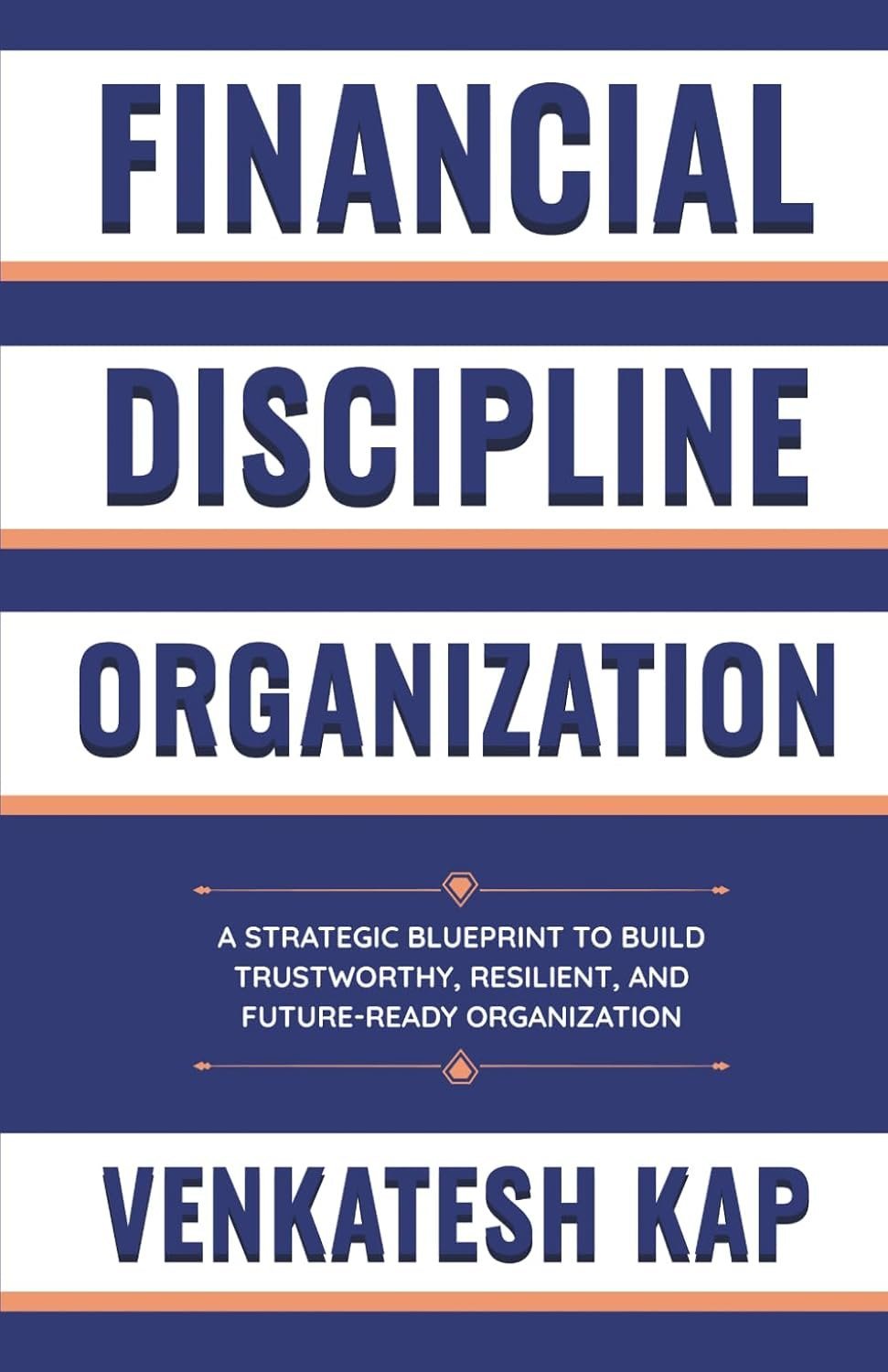
Financial Discipline Organization introduces the FDO Framework, an approach that treats financial discipline not simply as a control mechanism, but as an organization-wide capability that supports sustainable performance and resilience. At the heart of the framework are three interconnected elements: People, Process, and Price. The book explores how financially responsible organizations depend on people who understand the impact of their decisions, processes that create consistency and accountability, and pricing and financial choices that protect long-term organizational health.
Drawing on Venkatesh KAP’s experience in banking, credit management, loan portfolios, and distressed assets, the book examines how financial indiscipline can gradually weaken otherwise promising organizations. It highlights the importance of financial awareness beyond the finance department, showing how leadership decisions, governance, information flows, risk assessment, and operational practices can collectively influence financial stability.
The book also considers how organizations can move away from reactive decision-making and establish systems that provide greater clarity, control, and visibility. By integrating technology, reliable information, governance frameworks, and disciplined decision-making, the FDO approach aims to help organizations become better prepared for growth, uncertainty, and financial pressure.
This book is for entrepreneurs, CEOs, CXOs, business owners, finance professionals, managers, and organizational leaders responsible for growth, governance, risk, and financial decision-making. It is particularly relevant to organizations seeking to strengthen financial awareness, improve decision quality, reduce hidden financial vulnerabilities, and build the institutional discipline required for sustainable long-term growth.
Excerpt
From “The Hidden Threat Within”
Each day, most leaders spend much of their time focusing on the competition. Who will be the next new entrant to the market? Existing competitors' new product release, and who can innovate faster within that space?
But what happens if the actual "killer" is not an external threat, but rather, an internal issue within the organization that has crept in under the cover of short-term success and appears to be a strong performer relative to its competitors?
This internal killer is known as Financial Indiscipline. Financial indiscipline will never make the front page compared to other external threats, such as a competitor releasing a new product or a company being disrupted by external forces. Financial indiscipline does not knock at the door of your boardroom; it enters and takes root inside the organization through the innocuous accumulation of small choices and optimistic forecasts used to placate investors, such as taking out loans with no written plan on how to repay them, or utilizing excess budget within a department for unrelated expenditures that do not align with the organization’s long-term objectives.
Although these choices may initially seem harmless and rationalized, if not addressed promptly, they accumulate and contribute to an ongoing culture of Financial Indiscipline, eroding your organization's resilience and building distrust among employees. Another example of Financial Indiscipline is the story of a well-known startup that the media celebrated for its rapid success and considered a unicorn due to its rapid growth. Internally, however, it was burning through cash recklessly, enjoying lavish office interiors, incurring inflated hiring costs, and making acquisitions unrelated to its core business. Six months later, the same company that once graced magazine covers was unable to pay salaries on time. What outsiders saw as a sudden collapse was, in truth, the inevitable consequence of financial indiscipline that had been ignored for too long.
This is why financial indiscipline is a silent killer. It hides in plain sight, tolerated in the name of growth or strategy, until it suddenly manifests as a crisis. For leaders, the real question is not “Who is our biggest competitor?” but “Are we undermining ourselves from within?”
Defining Financial Indiscipline (FID)
Before they can confront a problem, leaders have to identify that problem. Many people equate Financial Indiscipline (FID) with a lack of proper accounting practices or poor financial management; however, FID is actually a more profound and more damaging issue.
“Accounting records what has happened. Financial management allocates what is. But financial discipline shapes what will happen. Without it, even the best accounting practices cannot prevent failure.”
Trailer
About the author

Founder & Ceo, Ebitaus · Chennai, India
Venkatesh KAP is a senior banking executive and Founder & CEO of Ebitaus, with nearly two decades of experience in credit, loan portfolio management, distressed assets, financial discipline, and organizational resilience.
Published by Stardom Books — written from the author’s own words, in the author’s name. Browse the catalogue
Start here
The Authority Quotient is a thirty-minute evaluation that measures your authority two ways — how you rate yourself, and what a stranger can verify — and ends with one specific recommendation, including which type of book is yours.
Find your Authority QuotientNo cost. Get detailed report. Includes specific recommendations.