Where to buy
Carried by Amazon in every market, Barnes & Noble, Walmart, Waterstones, Booktopia, Kinokuniya, Flipkart, Google Books, Apple Books and Kobo. Printed on demand close to wherever it is ordered.
Listed with the worldwide trade network, so any bookstore or library can order it. Ask for it by ISBN: 978-1957456737 (paperback).
What is inside
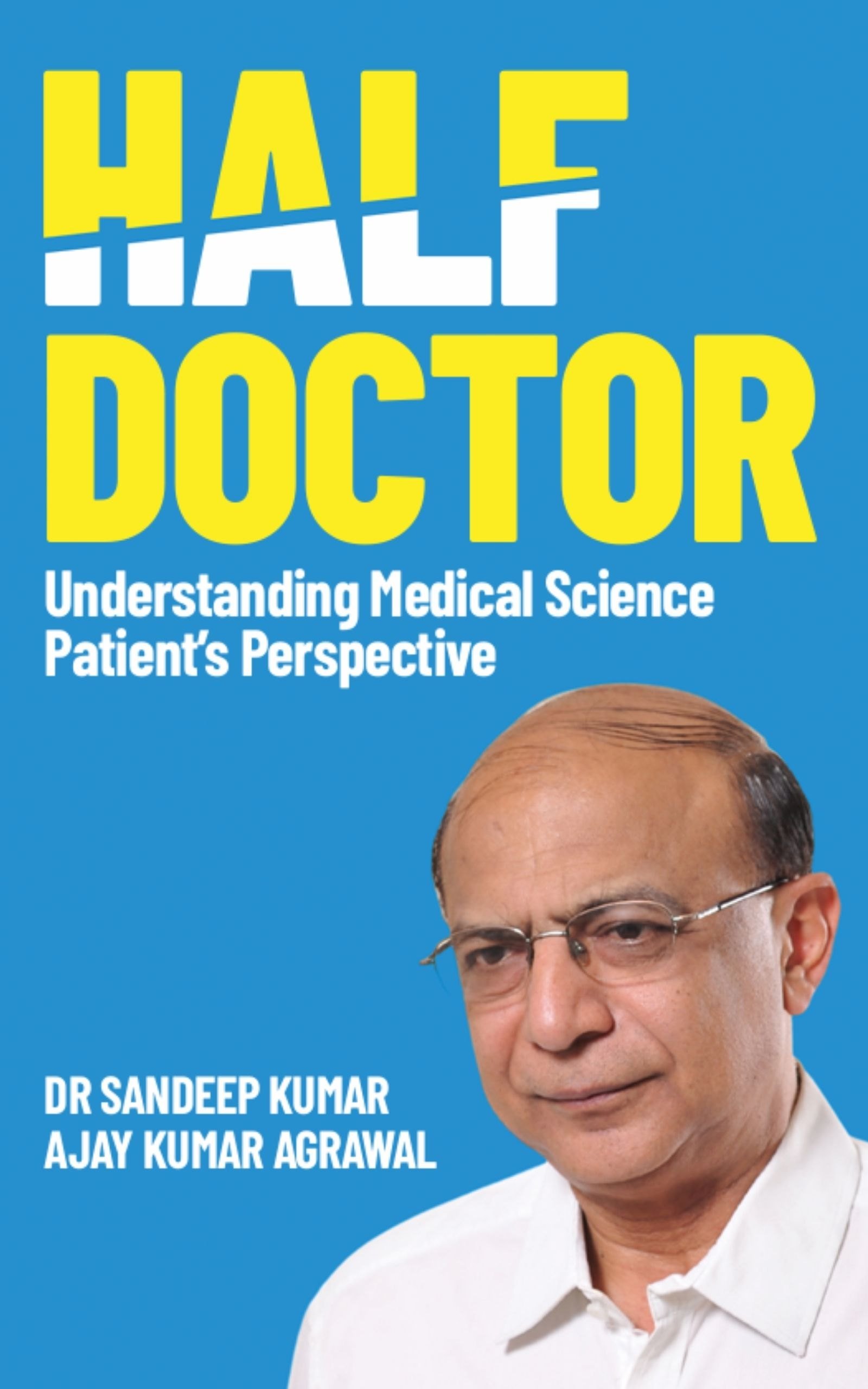
In Half Doctor: Understanding Medical Science: Patient’s Perspective, Dr. Sandeep Kumar and Ajay Kumar Agrawal bridge the gap between medical knowledge and everyday health awareness. Drawing on decades of clinical experience and a layperson’s perspective, they explain how readers can better understand their bodies, navigate healthcare systems, and participate actively in decisions about their treatment.
Across 50 chapters, the book begins with the structure of healthcare in India, the different types of medical facilities, patient rights, medical ethics, and public health programmes. It explains how to select a doctor or hospital, communicate effectively during consultations, understand diagnostic tests, and recognise symptoms that warrant medical attention.
The authors explore preventive healthcare, nutrition, immunity, evidence-based medicine, and the role of technology in modern healthcare, including telemedicine and artificial intelligence. They also examine traditional medical systems, medical misinformation, unqualified practitioners, and the importance of evaluating treatments scientifically.
The book then introduces common medical conditions and disorders affecting different parts of the body. Topics include diabetes, hypertension, heart disease, respiratory illnesses, cancer, neurological disorders, mental health, and digestive problems.
Readers will also find discussions on child and women's health, first aid, emergency care, health insurance, ageing, and end-of-life considerations.
Throughout the book, the authors emphasise that medical knowledge should support better communication with qualified healthcare professionals rather than replace professional diagnosis or treatment.
Half Doctor is written for individuals who want to understand their health, patients navigating medical treatment, and family members caring for loved ones.
It is also relevant to caregivers, paramedics, and medical students in the early stages of their careers.
By making medical concepts more accessible, the book aims to help readers ask informed questions, recognise important health concerns, and approach healthcare decisions with greater understanding.
Excerpt
From “Foreword”
Often, we either overlook minor ailments in our bodies or become overly concerned about a trivial disorder. Sometimes, we might become confused by information sourced from the internet. On certain occasions, we might exacerbate a small problem through unscientific self-treatment or by resorting to quackery.
In reality, quackery can lead us into a dangerous situation where a little knowledge becomes harmful, and a disease that could have been treated in its initial stage escalates into something more serious.
A symptom is a manifestation of a disease that the patient experiences, such as pain or a cough. In contrast, a sign is a discernible manifestation of the disease that a physician detects upon examination, such as an enlarged liver, a lump in the abdomen, raised blood pressure, or a hemorrhage in the retina. A disease represents a distinct abnormal process - a departure from a healthy state in the body with a specific cause and characteristic symptoms. On the other hand, a disorder signifies an irregularity or minor disruption of normal functions, typically temporary, and which generally resolves on its own.
While diseases may present with certain disorders, not every disorder is a disease. For instance, constipation may simply be a disorder commonly caused by changes in lifestyle, travel, or diet. However, constipation can also be a symptom of a more serious disease, such as growth or cancer in the large intestine. Despite these distinctions, the terms “disease” and “disorder” are often used interchangeably.
Disability can be mental or physical. Complete impairment or any significant restriction in mental or physical capability is defined as a disability.
Syndrome: This term refers to a group of symptoms and signs that occur together, potentially due to various underlying causes. For example, nephrotic syndrome, characterized by body swelling, protein in the urine, low levels of albumin in the blood, and increased cholesterol, occurs due to many kidney disorders.
Symptoms or diseases are classified as acute when they develop rapidly over a short period or chronic when they persist over an extended time.
If one or more symptoms persist for more than 4 - 5 days, seeking proper medical treatment is advisable.
Trailer
About the author

Writer, Cultural Scholar · Uttar Pradesh, India
Ajay Kumar Agrawal is a writer and retired Joint Director of Uttar Pradesh's Department of Culture. A postgraduate in Political Science.
About the author
Surgeon, Breast specialist, and surgical oncologist., Dr Sandeep Kumar's Clinic · Uttarpradesh, India
Dr. Sandeep Kumar is a surgeon, former Professor at King George’s Medical University and founding Director of AIIMS Bhopal. With over 150 research papers.
Published by Stardom Books — written from the author’s own words, in the author’s name. Browse the catalogue
Start here
The Authority Quotient is a thirty-minute evaluation that measures your authority two ways — how you rate yourself, and what a stranger can verify — and ends with one specific recommendation, including which type of book is yours.
Find your Authority QuotientNo cost. Get detailed report. Includes specific recommendations.