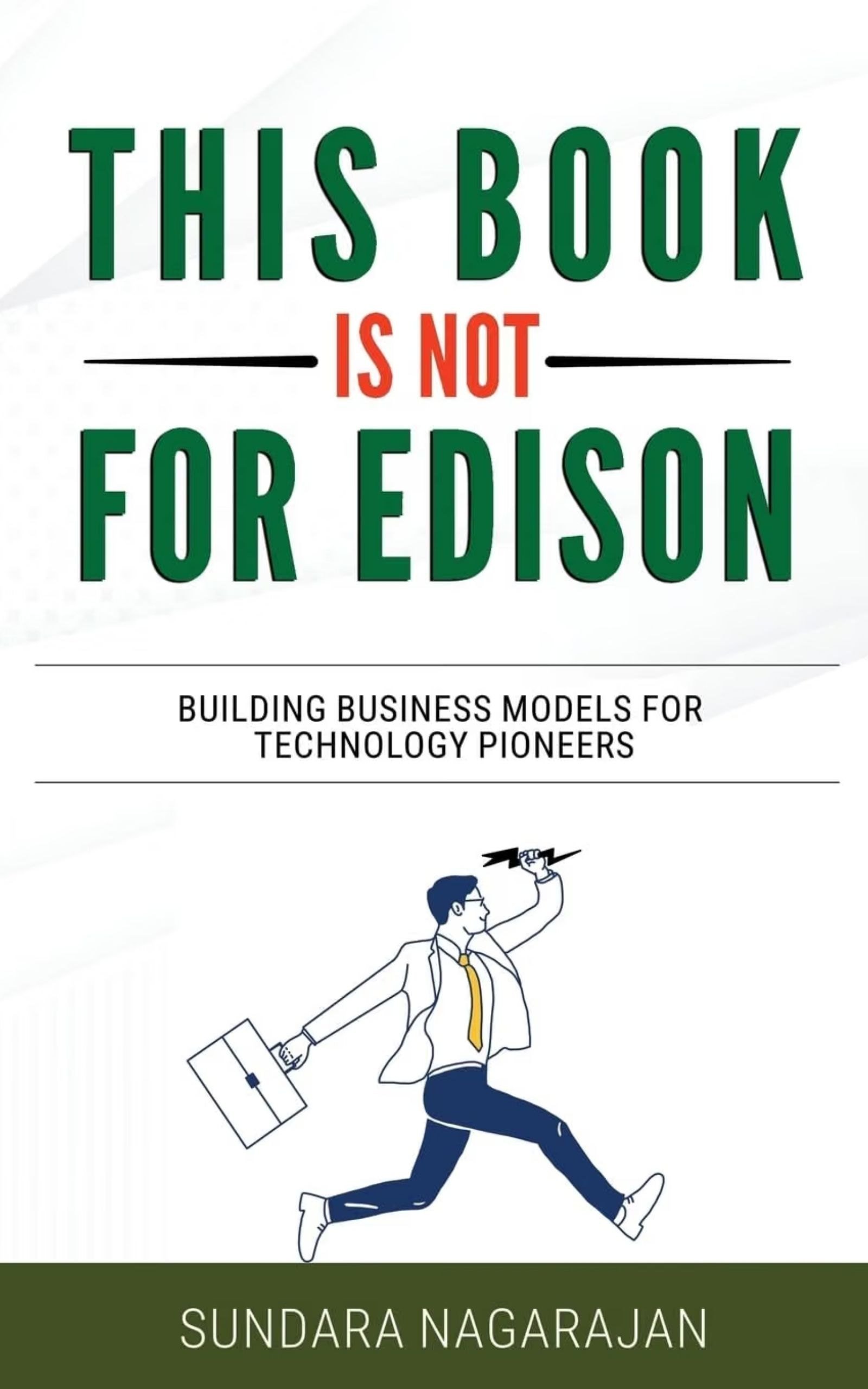
Where to buy
Carried by Amazon in every market, Barnes & Noble, Walmart, Waterstones, Booktopia, Kinokuniya, Flipkart, Google Books, Apple Books and Kobo. Printed on demand close to wherever it is ordered.
Listed with the worldwide trade network, so any bookstore or library can order it. Ask for it by ISBN: 978-1957456317 (paperback).
What is inside
A breakthrough idea is only the beginning. Building a sustainable company requires a clear understanding of customers, business models, financial decisions, leadership, and the challenges of scaling.
In This Book Is Not for Edison: Building Business Models for Technology Pioneers, Sundara Nagarajan draws on his experience in technology and entrepreneurship to help founders develop the business perspective needed to transform innovation into economic value.
The book begins by examining the transition from technical expert to startup CEO. It explores why promising ventures encounter difficulties and how founders can identify gaps in their preparedness before those gaps threaten the business.
Readers will discover the importance of customer discovery, validating assumptions, defining a compelling value proposition, and achieving product-market fit. The book explains how to develop business models that create, deliver, and capture value while navigating the challenges of bringing new technology to market.
Financial management is another central theme. Sundara examines cash flow, unit economics, capital optimisation, and the distinction between productive investments and losses that put a company at risk.
The book also addresses strategic planning, performance measurement, team development, fundraising, and the responsibilities of entrepreneurial leadership. Chapter-level takeaways and action-planning exercises encourage readers to apply the concepts to their own ventures.
Rather than promising a universal formula for success, it introduces frameworks and perspectives that founders can adapt to their circumstances.
This Book Is Not for Edison is written for first-time technology founders, aspiring entrepreneurs, scientists, researchers, engineers, and product developers seeking to commercialize their innovations.
It is also relevant to corporate intrapreneurs, leaders of technology-based businesses, digital transformation professionals, investors, incubator teams, mentors, and startup advisors.
The book helps readers examine what it takes to move beyond building a product and begin building a business capable of sustaining and scaling its impact.
Excerpt
From “1 Congratulations! You Are Promoted As the CEO”
Ideas are solutions to a perceived or experienced problem. We get excited and begin to build the solution too soon, create a demo, and tell the story, raise the money, and scale. This is the root cause of most startup failures. Every new business idea is essentially a bunch of assumptions, some of which are killer assumptions. You can’t challenge or validate your assumptions in your lab or worktable. As Steve Blank says, “Get out of the building!” (5).
In the context of entrepreneurship, in all cases, it is crucial to establish a strong foundation for your idea before you start building the solution. It is to formulate the problem your idea is proposing to solve. Ideally, this must be completed before the founder leaves their current occupation. Successful founders are optimistic realists—trigged by intuition, but they validate with facts—data, observed behaviors, etc.
Common risks observed with technology-focused founders are:
Assuming everyone suffers the problem and is looking for a solution immediately.
A belief that customers must experience a new product before they can say how much they will pay for it.
Trying to solve too many problems for too many types of customers.
The only entity who can answer all your questions and help you validate your assumptions is the beneficiary user and the customer (the one who pays you.) We shall refer to both together as “customer” unless there is a need to separate. There are only two effective ways to do this.
Talk directly to your customers and partners and observe their behaviors.
Design and run experiments to put people through experiences and observations.
Founders have many excuses for not meeting their customers—"I don’t have anything to show; we are not ready with our demo; I will talk to them when the minimum viable product is ready,” and so on. The real reason is a fear of facing reality—moving from the world of abstraction to the world of real people. It is only postponing the problem to a later day when the cost of solving it is much higher. Not establishing the problem is a major defect in the startup process, and it is the cheapest to solve it earliest in the life cycle.
This activity is referred to as Customer Discovery and what follows is called Customer Validation, (6) and it leads to a clear product vision.
Trailer
About the author

MD, Innovation Scaleup Advisors · Bangalore, India
“Raam's coaching helped me plan my first book. Stardom Books supported and encouraged me throughout the journey. I don't think I could have published it without their help .”
Sundara Nagarajan (SN) is a technologist with over 30 years of experience and Managing Director of Innovation Scaleup Advisors. An educator and coach, he helps technology founders build and scale innovation-led firms.
Published by Stardom Books — written from the author’s own words, in the author’s name. Browse the catalogue
Start here
The Authority Quotient is a thirty-minute evaluation that measures your authority two ways — how you rate yourself, and what a stranger can verify — and ends with one specific recommendation, including which type of book is yours.
Find your Authority QuotientNo cost. Get detailed report. Includes specific recommendations.