Where to buy
Carried by Amazon in every market, Barnes & Noble, Walmart, Waterstones, Booktopia, Kinokuniya, Flipkart, Google Books, Apple Books and Kobo. Printed on demand close to wherever it is ordered.
Listed with the worldwide trade network, so any bookstore or library can order it. Ask for it by ISBN: 979-8950206122 (paperback) or 979-8950206139 (hardcover).
What is inside
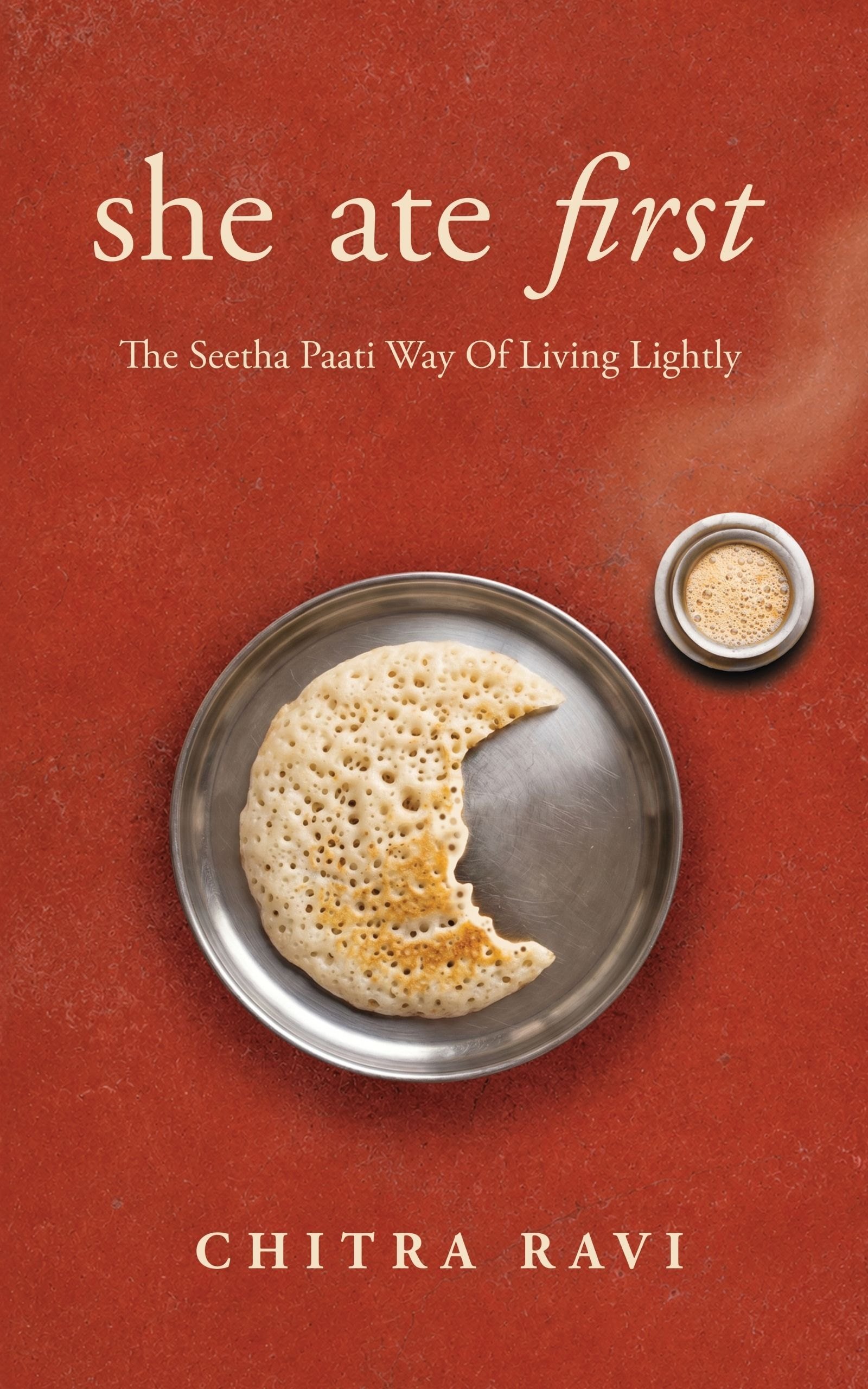
In She Ate First: The Seetha Paati Way of Living Lightly, Chitra Ravi explores this question through the life of her grandmother, Seetha Paati, a woman who raised twelve children, lived through profound loss and change, and yet remained remarkably steady, curious, affectionate, and present. Rather than teaching through rules or advice, Seetha Paati showed what it meant to live well through the small choices she made every day.
Across ten reflective chapters, Chitra revisits these ordinary moments and discovers the wisdom within them. Care explores listening to the body and recognising that caring for yourself is not selfish. Rest considers the permission to pause without guilt. Release asks what we are carrying that was never truly ours. Anchor reflects on faith and the practices that help us return to steadiness. Wonder and Learn celebrate curiosity and lifelong learning, while Cherish examines contentment in a world shaped by comparison.
Surrender explores the freedom of letting go of control, Arise reflects on quiet courage, and Empathise considers what it means to truly make space for another person. Each chapter is accompanied by a verse from the Bhagavad Gita and a question for personal reflection.
This book is for anyone who feels capable yet quietly depleted, especially women balancing family, work, relationships, and expectations. It is also for readers drawn to memoir, intergenerational wisdom, mindful living, and the lessons hidden within ordinary family life. She Ate First does not prescribe a better life. It invites readers to notice what living a little lighter might look like in their own.
Excerpt
From “WHERE IT BEGINS”
Ambi, let me have my oats first. Then, you can drop me at Veni’s house on your way to the office.” She said it simply, as a matter of fact. In a culture where women always ate last, this sounded almost out of place.
Seetha Paati carried no guilt in leaving her husband, my Thatha, behind. He was rarely willing to leave his favourite sofa, while she went off to recharge herself at her daughter’s home. Before she left, she ensured his routine would not be disturbed, and through the day, she would check in over a phone call.
She had memorised the numbers of all those who mattered to her. “Rukmani, thallikko. I’ll make iluppa chatti dosai for the children myself,” she would say in the kitchen, and Rukmani, my mother and her daughter-in-law, would simply move aside with a smile, already half-expecting it. “I think I am getting a cold, let me make my kashayam before you start cooking.” “Ambi, enakku marundu venum da.” That evening, the medicine she had demanded would arrive promptly when my father, her son, fondly called Ambi, returned from his office.
There were times when her own daughters would tease her. “Amma, you and your oats first. At least pretend to serve Appa before you sit down.” Or in hushed voices, “Look at her, always thinking of herself first.” They said it laughingly, half in jest, half in mild disbelief. In a generation trained to equate sacrifice with virtue, her insistence on eating first looked different, almost rebellious.
Most women around her would wait until everyone had eaten before serving themselves. Meals were interrupted constantly, someone needing another dosa, a glass of water, coffee to be reheated, something forgotten in the kitchen. By the time they finally sat down, the food was often cold and the body already tired.
But Paati never seemed to believe that care for others required the complete abandonment of oneself. She would just smile and say, “If I don’t eat now, I won’t get time later.”
I learned my earliest lessons about self-care not from books or instruction, but by watching Seetha Paati. She would almost always eat first and then turn to tending to the family. Looking back, what they called “selfish” feels to me like self-respect.
She did not diminish her care for others. She strengthened it
Trailer
About the author

Founder & Ceo, Chrysalis · Chennai, India
Chitra Ravi is Founder & CEO of Chrysalis, impacting 500,000+ children across India. An ET Game Changer awardee, TEDx speaker, mindfulness trainer and Advaita Vedanta student, she is the author of She Ate First.
Published by Stardom Books — written from the author’s own words, in the author’s name. Browse the catalogue
Start here
The Authority Quotient is a thirty-minute evaluation that measures your authority two ways — how you rate yourself, and what a stranger can verify — and ends with one specific recommendation, including which type of book is yours.
Find your Authority QuotientNo cost. Get detailed report. Includes specific recommendations.