Where to buy
Carried by Amazon in every market, Barnes & Noble, Walmart, Waterstones, Booktopia, Kinokuniya, Flipkart, Google Books, Apple Books and Kobo. Printed on demand close to wherever it is ordered.
Listed with the worldwide trade network, so any bookstore or library can order it. Ask for it by ISBN: 979-8950206092 (paperback).
What is inside
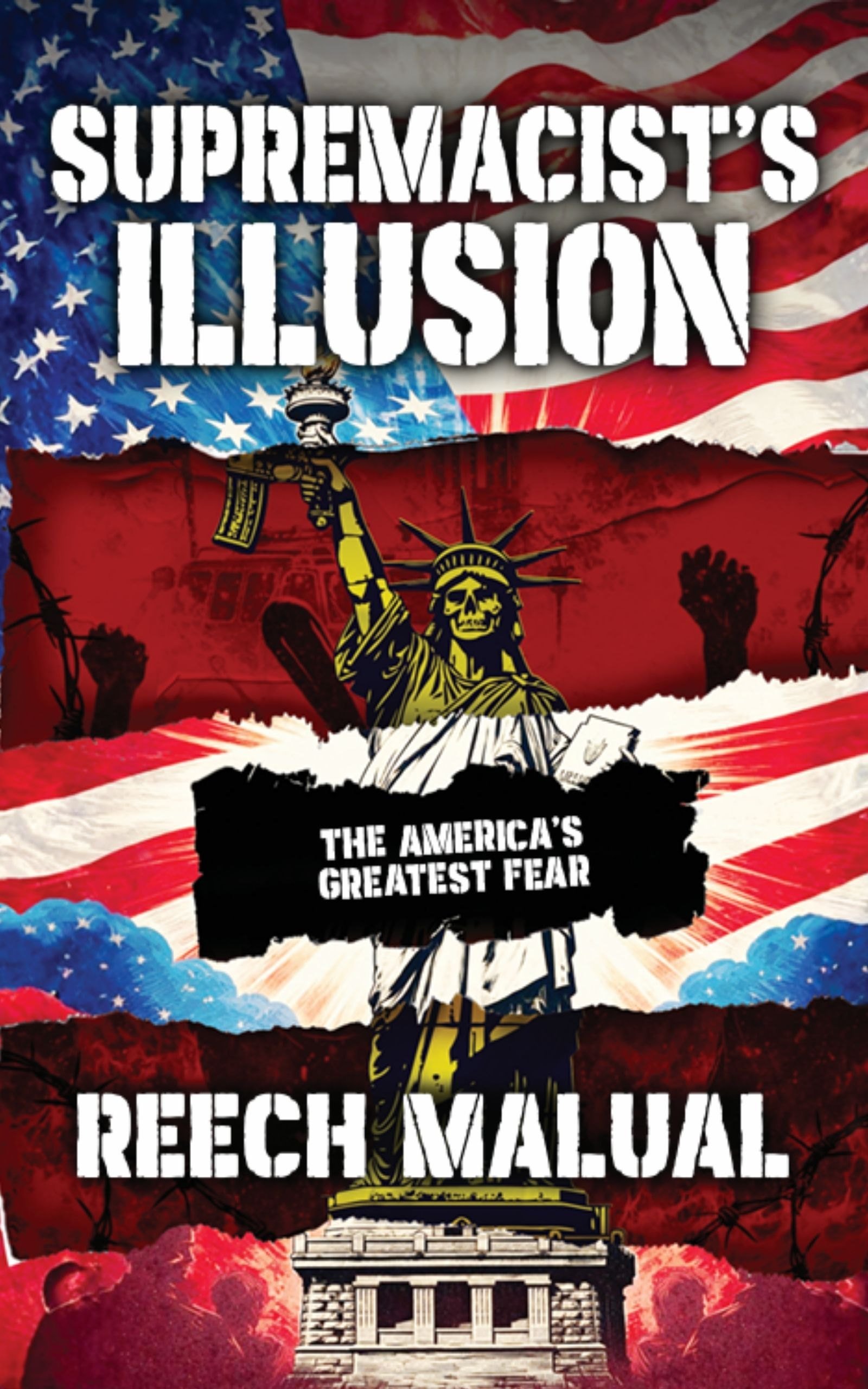
In Supremacist’s Illusion: The America’s Greatest Fear, Reech Malual examines the cultural, racial, religious, political, and economic divisions that influence contemporary American society. The book considers how historical narratives, perceptions of national identity, demographic change, social inequality, and fears surrounding cultural transformation contribute to polarization and competing ideas of what it means to be American. SUPREMACIST'S ILLUSION 19-06-26
Drawing on research as well as observations from his time in the United States, Malual explores perspectives connected with Black, White, Jewish, Muslim, Indigenous, and LGBTQ+ communities. Rather than treating division through a simple “us versus them” framework, the book examines the grievances, fears, historical experiences, and belief systems that shape different communities and ideological positions.
SUPREMACIST'S ILLUSION 19-06-26
The discussion extends to white supremacy, Christian nationalism, cultural homogeneity, systemic discrimination, reproductive rights, immigration, demographic shifts, economic inequality, and the relationship between economic power and democratic participation. It also considers the role of dialogue, empathy, shared identity, and greater understanding in addressing social fragmentation.
This book is for readers interested in American society, race and identity, political and social divisions, discrimination, migration, cultural change, and the forces that influence belonging and national cohesion.
It may be particularly relevant to students, researchers, journalists, policymakers, social science readers, community leaders, and anyone seeking to examine competing perspectives on inequality, identity, and the changing American social landscape.
Excerpt
From “Dedication”
The United States of America, often envisioned as a dream destination, simultaneously grapples with a complex history marred by narratives of police brutality, systemic racism, hate speech, and a deeply rooted culture of segregation. My journey began on June 20th, 2023, when I first arrived in Washington, D.C., before proceeding the following day to Detroit, Michigan. There, Wayne State University became my academic home for six weeks, as I immersed myself in the Institute of Leadership Studies, guided by exceptional professors and experts.
During my leadership scholarship at Wayne State, I had invaluable opportunities to engage with local families and communities, aiming to understand America through personal conversations and direct observation. A recurring observation was the quiet suffering within communities, evident in numerous abandoned homes and entire neighborhoods. While reasons for this phenomenon are complex and multifaceted, ranging from labor migration and demographic shifts to evolving societal values, it underscores a profound aspect of American life.
A particularly striking revelation was the divergent perspectives on the Fourth of July that I personally attended with colleagues. I observed that many Black Americans do not celebrate this day as a universal symbol of independence for the United States. In contrast, White America largely embraces it as such. This stark difference became a pivotal inspiration for this book, which I completed almost 3 years after my visit. For many Black Americans, June 19th, commemorating the end of slavery, holds greater significance as a true day of liberation. The Fourth of July, they often contend, represents incomplete freedom, given that slavery persisted for another 89 years after the Declaration of Independence was signed. This realization that Black America often views July 4th through a different lens compelled me to delve deeper into the intricate American narrative, both for my own understanding and to help others comprehend the complexities of this remarkable nation.
Leveraging my Arabic knowledge, I also sought to understand the challenges faced by Muslim Americans. My research further extended to explore the stories of White America, LGBTQ+ America, Jewish America, and Native America, in addition to the economic segregation faced by them. It was a profound experience to move beyond prevailing stereotypes and to instead embrace the nuanced realities of each group, presenting both their self-told narratives and the perceptions often held by others. Allowing narratives of white supremacy and police brutality to dominate the American story risks portraying the U.S. as a nation still mired in an apartheid-like past, echoing an outdated era. This book aims to contribute to a more comprehensive understanding, fostering dialogue that acknowledges the full spectrum of American experiences.
Trailer
About the author

Managing Partner, Akumric Law House · Juba, South Sudan
Reech Malual is a South Sudanese legal and media professional, journalist, editor, broadcaster, and consultant. His work spans peace journalism, media ethics, conflict reporting, and press freedom across South Sudan.
Published by Stardom Books — written from the author’s own words, in the author’s name. Browse the catalogue
Start here
The Authority Quotient is a thirty-minute evaluation that measures your authority two ways — how you rate yourself, and what a stranger can verify — and ends with one specific recommendation, including which type of book is yours.
Find your Authority QuotientNo cost. Get detailed report. Includes specific recommendations.