Where to buy
Carried by Amazon in every market, Barnes & Noble, Walmart, Waterstones, Booktopia, Kinokuniya, Flipkart, Google Books, Apple Books and Kobo. Printed on demand close to wherever it is ordered.
Listed with the worldwide trade network, so any bookstore or library can order it. Ask for it by ISBN: 978-1732328761 (paperback).
What is inside
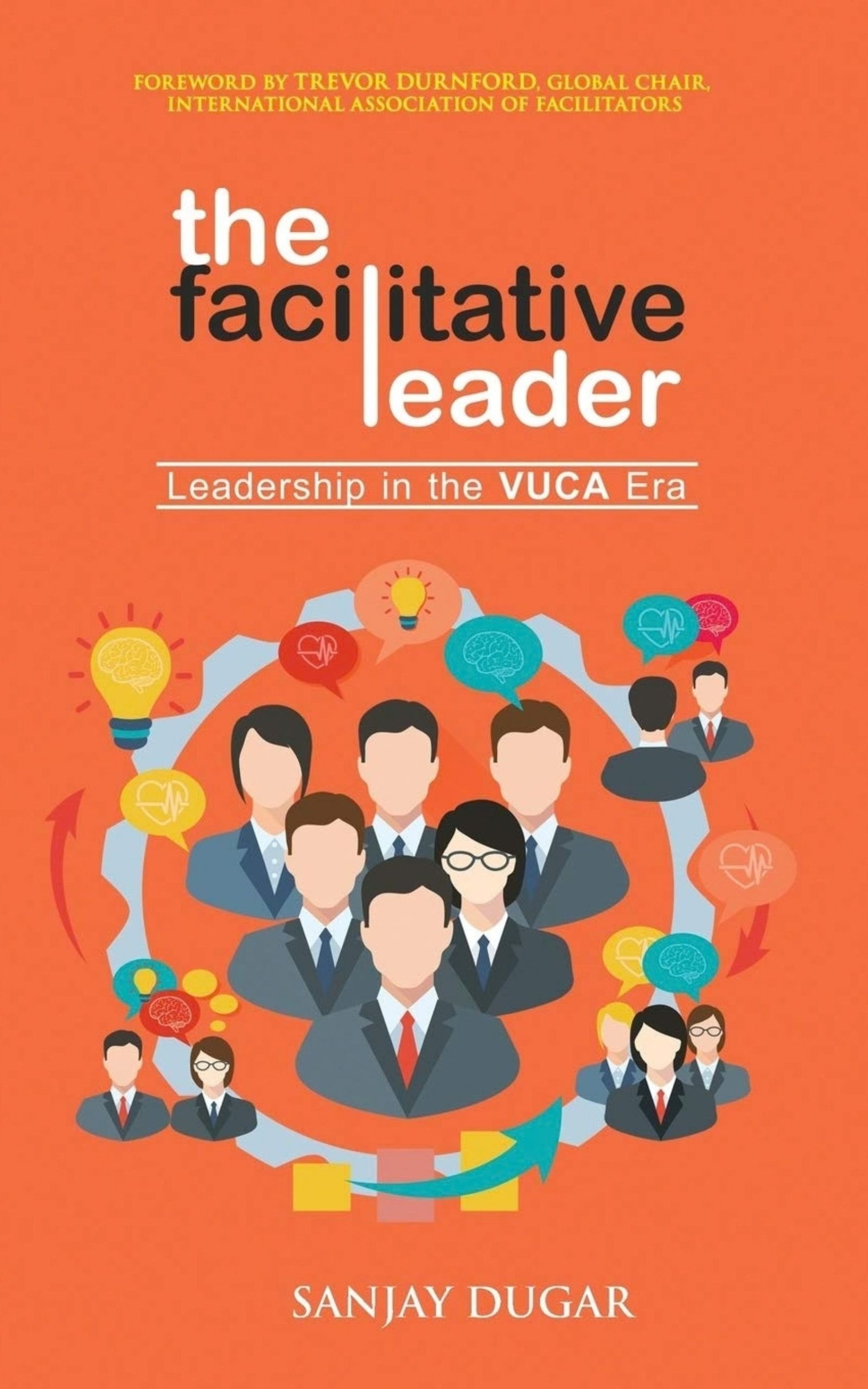
The Facilitative Leader by Sanjay Dugar explores how leadership has changed over time in response to shifts in society, business, technology, and organisational expectations. The book traces this evolution through different phases, including the Personality Era, Influence Era, and Transformational Era, before making the case for what the author describes as the emerging Facilitator Era.
At the centre of this new approach is a shift in the leader’s role. Rather than being the person expected to hold all the answers, the facilitative leader creates the conditions in which people can think, contribute, collaborate, and perform effectively. The book examines how leaders can move from directing people toward enabling them, while still maintaining clarity, accountability, and organisational focus.
Drawing on Sanjay Dugar’s experience in leadership development and organisational transformation, the book explores the skills and mindset required to facilitate stronger conversations, build capable teams, navigate change, and help people take greater ownership of outcomes.
The book also considers why traditional leadership approaches may become less effective as workplaces grow more complex and employees become more knowledgeable, interconnected, and independent.
The Facilitative Leader is written for managers, senior executives, entrepreneurs, HR professionals, educators, and aspiring leaders seeking to adapt their leadership style to changing organisational realities.
It is particularly relevant to those who want to strengthen collaboration, develop future-ready teams, enable others to perform, and understand why facilitation is becoming an increasingly important leadership capability.
Excerpt
From “Title Page”
At the airport, having checked in for my flight back home, after a good four consecutive days of traveling across multiple destinations, I was impatiently waiting at the gate, standing in the queue along with others who were as impatient as me.
There was a buzz of activity at the counter ahead of us, and I began wondering what was going on. Suddenly, the sound system started with a crackle, and a woman’s voice came alive to say that my flight was delayed by four hours with the new ETD showing 03:00 hours.
Of course, the reason cited for such delays is always very vague, and in this case too, the familiar announcement was made – “delayed due to the late arrival of the incoming flight.” I was upset, but quickly resigned to the fate and reconciled with myself to make the most of the time I had before me now. Already weary with the multi-city travel, all I could do was let out a sigh. I did not have the energy to go around the shops at the airport that were trying to attract me with big sale signs and discount offers, with impeccably dressed sales girls.
Meanwhile, I was too tired to go and find out what was really going on about the delay. Seeing the people at the gate counter expressing their annoyance in very loud voices, and the soft voice of the customer relations executive there trying to stay calm as much as she could, I also realized that it would be pointless for me to add to that crowd.
So I just curled up on one of those recliner seats. I dug out some reading material that I had stashed away in my laptop backpack and started to read some of the research papers on leadership styles, that I had printed out last week, but had not had the time to read them. As I was reading these research papers, a few questions I found myself asking were, Why are the leadership styles changing? What is causing this change? Does this mean that leadership methods would change again?
While grappling with these questions, another thought around the time dimension crept into my mind – “Have we reached the point where the next evolution is needed?” The more I ran these questions over in my mind, and the recent situations where I was helping a few leaders, I was convinced that it was about time. This was the trigger that got me to start writing this book. It is said that you get good lessons from history, to be able to plan for the present and the future.
Trailer
About the author

Director - Client Management, C2C Organizational Development · Bangalore, India
Sanjay Dugar, MBA, CPF, is Director of C2C Organizational Development Pvt. Ltd. A leadership facilitator with deep IT and ITeS experience, he is known for calm crisis management, turnaround thinking, and helping leaders excel.
Published by Stardom Books — written from the author’s own words, in the author’s name. Browse the catalogue
Start here
The Authority Quotient is a thirty-minute evaluation that measures your authority two ways — how you rate yourself, and what a stranger can verify — and ends with one specific recommendation, including which type of book is yours.
Find your Authority QuotientNo cost. Get detailed report. Includes specific recommendations.