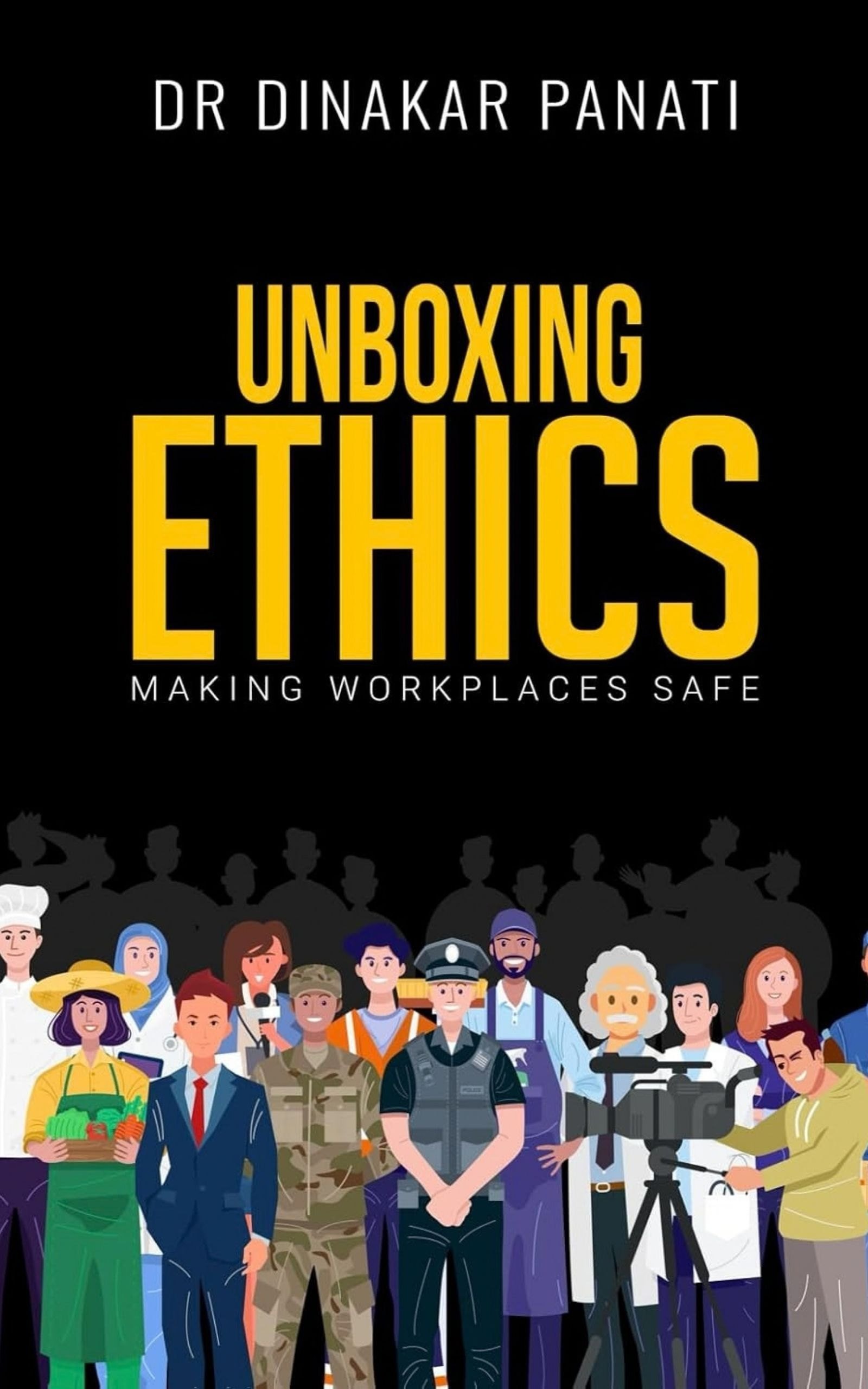
Where to buy
Carried by Amazon in every market, Barnes & Noble, Walmart, Waterstones, Booktopia, Kinokuniya, Flipkart, Google Books, Apple Books and Kobo. Printed on demand close to wherever it is ordered.
Listed with the worldwide trade network, so any bookstore or library can order it. Ask for it by ISBN: 978-1957456164 (paperback).
What is inside
Unboxing Ethics: Making Workplaces Safe by Dr. Dinakar Panati examines the behaviours and workplace habits that can gradually turn an organisation into an unhealthy environment. It looks at how actions that are often dismissed as normal, such as yelling, bullying, excessive workloads, intimidation, and disrespect, can affect employee wellbeing, motivation, productivity, and retention.
The book encourages employees to recognise harmful workplace patterns and understand how they can respond to difficult situations while protecting their professional growth and wellbeing. It also addresses the challenges faced by individuals who feel trapped between remaining in an unhealthy workplace and the uncertainty of leaving it.
For leaders and employers, the book focuses on the responsibility of creating an environment where people can express themselves, make mistakes, learn, and contribute without fear. It highlights the importance of self-awareness among leaders and encourages a culture built on respect, empathy, accountability, and constructive communication.
Rather than treating workplace toxicity as an unavoidable part of professional life, Dr. Panati argues for a more ethical approach to organisational culture, one in which employee wellbeing and performance can support each other.
The book is written for employees experiencing difficult workplace environments, managers seeking to understand their impact on teams, and leaders responsible for shaping organisational culture.
It is also relevant to HR professionals, entrepreneurs, business owners, and professionals who want to build safer, more respectful, and productive workplaces where people can develop and contribute with confidence
Excerpt
From “Acknowledgments”
If you wish to pan away from the silver screen and focus on brass tacks, here’s another morbidly grim statistic: 94 percent of the American employees have reportedly experienced stress at their workplace, and 7 in 10 Indians face pressure at work every single day. Every field of work is accompanied by pressure: Be it the corporate workforce, which has to meet its daily targets and deadlines while dealing with toxic work environments and the humdrum of a monotonous 9 to 5 life, while balancing a proper home life; the overworked surgeon who pushes his/her own life, family, and health aside and remains on call 24/7 carrying the weight of literally saving lives and studying away in the hours left; or the A-list actor who needs to memorize, rehearse, and film five to seven scenes with the same intensity and quality over a gazillion takes while clocking daily 16- to 20-hour shifts, foregoing rest and sleep.
Pressure, deadlines, and expectations are everywhere around us. However, most people complain of excessive and unwanted stress. There could be numerous factors behind this, which if not addressed on time and in the correct manner, could make the situation untenable. However, before we explore these aspects, let me take a moment to brief you on the importance of this chapter.
Workplace toxicity is not a foreign concept. If you perform an internet search looking for reviews on any particular workplace, you will be served with a plethora of brutal comments and bittersweet anecdotes, where people expose the toxic underbelly of the workplace in question.
Some people even upload videos on YouTube, bearing the recordings of the not-so-nice conversations they have had with their bosses, thus unveiling the toxicity that lurks in the shadowy corners of the workplace. It will not be entirely wrong to say that your family and friends had urged you to check out the possible red flags when you signed that job letter. Some people even share personal horror stories to make you wary of the potential hazards that await you.
Such warnings might have raised your antenna, probably making you more observant about and guarded against those signs. You could be reading this book for the very same reason. You may now be looking for ways to negotiate these potential threats and even seeking help by researching tips, strategies, and coping mechanisms on the most informal websites, such as Quora and Reddit.
Dear reader, you have arrived at the right place if you have been sailing on that boat. In fact, you are one of the lucky ones who have noticed the toxic signs in time. Toxic work practices and cultures have become so widely institutionalized that they have become the norm.
About the author

Head of Regulatory and Business, Epygen Biotech · Mumbai, India
Dr. Dinakar Panati is Head of Regulatory and Business at Epygen Biotech Pvt. Ltd. A PhD holder with PMP and Lean Six Sigma certifications, he advocates kindness, positive workplace culture, social work, and career coaching.
Published by Stardom Books — written from the author’s own words, in the author’s name. Browse the catalogue
Start here
The Authority Quotient is a thirty-minute evaluation that measures your authority two ways — how you rate yourself, and what a stranger can verify — and ends with one specific recommendation, including which type of book is yours.
Find your Authority QuotientNo cost. Get detailed report. Includes specific recommendations.