Where to buy
Carried by Amazon in every market, Barnes & Noble, Walmart, Waterstones, Booktopia, Kinokuniya, Flipkart, Google Books, Apple Books and Kobo. Printed on demand close to wherever it is ordered.
Listed with the worldwide trade network, so any bookstore or library can order it. Ask for it by ISBN: 978-1957456492 (paperback).
What is inside
Customer success is more than managing relationships after a sale. It requires a structured approach that connects customer needs, business objectives, and organizational capabilities. Yet, building an effective customer success function can be challenging, particularly when companies are growing, expanding into new markets, or managing increasingly complex customer expectations.
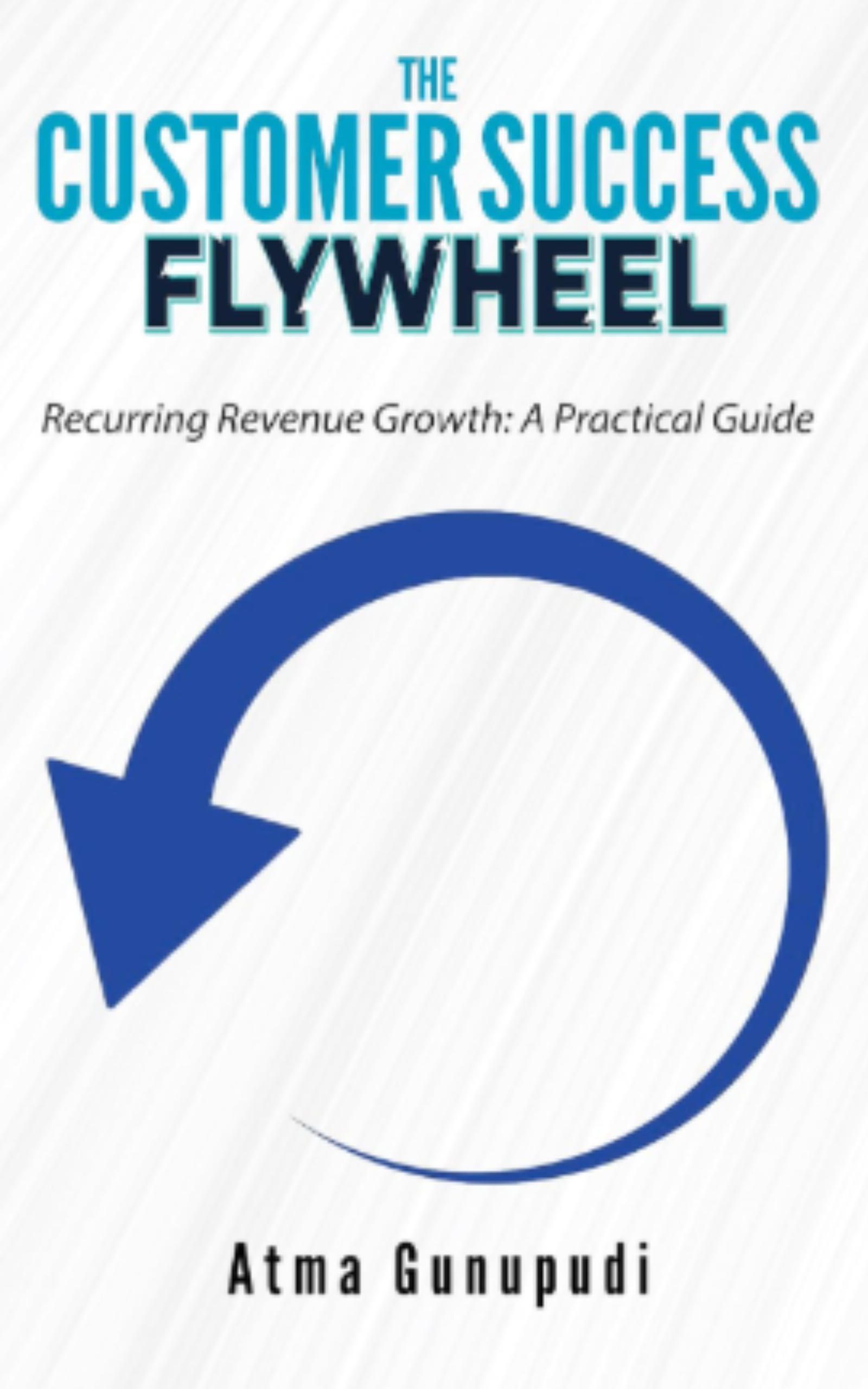
In The Customer Success Flywheel: Recurring Revenue Growth, A Practical Guide, Atma Gunupudi draws on his extensive experience in customer success to provide a practical roadmap for establishing, managing, and scaling customer success functions.
The book explores the essential elements of building high-performing customer success teams, including organizational structure, clearly defined roles and responsibilities, leadership recruitment, compensation frameworks, and the selection of appropriate tools.
It also examines the importance of understanding customers beyond their immediate requirements. Readers learn how to approach customer success planning by studying industry dynamics, identifying business objectives, recognizing key stakeholders, and aligning products and services with measurable customer value.
A central theme of the book is that customer success strategies must evolve with the organization. Rather than advocating a one-size-fits-all approach, Atma explains how businesses can adapt their customer success functions to different organizational sizes, levels of maturity, and stages of growth.
Written for CXOs, Chief Customer Officers, CEOs of small and medium-sized enterprises, startup founders, and customer success leaders, the book provides guidance for professionals seeking to establish new customer success functions or strengthen existing ones.
It is equally relevant to growing organizations looking to bring greater structure, clarity, and consistency to their post-sales operations.
The Customer Success Flywheel connects practical frameworks with professional experience, helping business leaders understand how customer success can contribute to stronger relationships, recurring revenue growth, and long-term organizational sustainability.
Excerpt
From “PART 1: SAAS AND CS”
In this chapter THE BLUEPRINT: CUSTOMER SUCCESS PLAN, we will cover the crucial aspects of understanding your customer and their success criteria. I would also like to explore the customer success plan, an invaluable tool I have extensively used throughout my career as a customer success professional. The customer success plan is a powerful resource that equips CS teams to drive the success of their customers, particularly large enterprise clients who have multiple moving parts. It serves as a comprehensive blueprint for achieving customer success.
The first step in truly knowing and serving your customers is to conduct extensive research on their industry. Understanding the dynamics of their industry is crucial. This requires understanding the various factors influencing the industry, including how government policies like data residency rules or other macroeconomic conditions impact customers’ tool or service choices.
Some mature B2B SaaS companies have established industry-specific success teams to cater to specific industries. Assigning a customer success manager specializing in a particular sector enhances expertise and addresses unique customer needs. Companies can better understand their customers, build collective expertise, improve problem-solving capabilities, and gain a competitive advantage by focusing on industry verticals.
Another crucial aspect of knowing your customer is understanding their business plan and model. This involves answering important questions about their monetization plan, profitability, solvency, bottom line, and priorities. It is also crucial to identify their sustainable competitive advantage. It is important to determine how your product or service enhances or impacts their business plan, specifically their sustainable competitive advantage.
Every organization member, from CSMs to executives and support teams, must know the product or service’s key value proposition. This value proposition can be categorized as cost reduction, revenue increase, or providing valuable insights via data analytics. Creating an effective “elevator pitch” for the organization ensures consistent understanding and communication of the product’s value proposition.
Another crucial aspect of understanding your customer is recognizing the key stakeholders involved. There are diverse groups of stakeholders with varying personalities and levels of maturity across different spectrums of your operations. These stakeholders include buyers in enterprise organizations, SMB organizations, legal teams, information security teams, executives, and end-users.
It is important to understand that there is a distinction between those making purchasing decisions and those who use the product. To succeed, your product must be appealing to both end-users and buyers.
Trailer
Published by Stardom Books — written from the author’s own words, in the author’s name. Browse the catalogue
Start here
The Authority Quotient is a thirty-minute evaluation that measures your authority two ways — how you rate yourself, and what a stranger can verify — and ends with one specific recommendation, including which type of book is yours.
Find your Authority QuotientNo cost. Get detailed report. Includes specific recommendations.