Where to buy
Carried by Amazon in every market, Barnes & Noble, Walmart, Waterstones, Booktopia, Kinokuniya, Flipkart, Google Books, Apple Books and Kobo. Printed on demand close to wherever it is ordered.
Listed with the worldwide trade network, so any bookstore or library can order it. Ask for it by ISBN: 978-1957456362 (paperback).
What is inside
A clear business strategy alone is not enough to build a successful organisation. When goals, values, leadership, and everyday actions are disconnected, even promising businesses can struggle to achieve their potential.
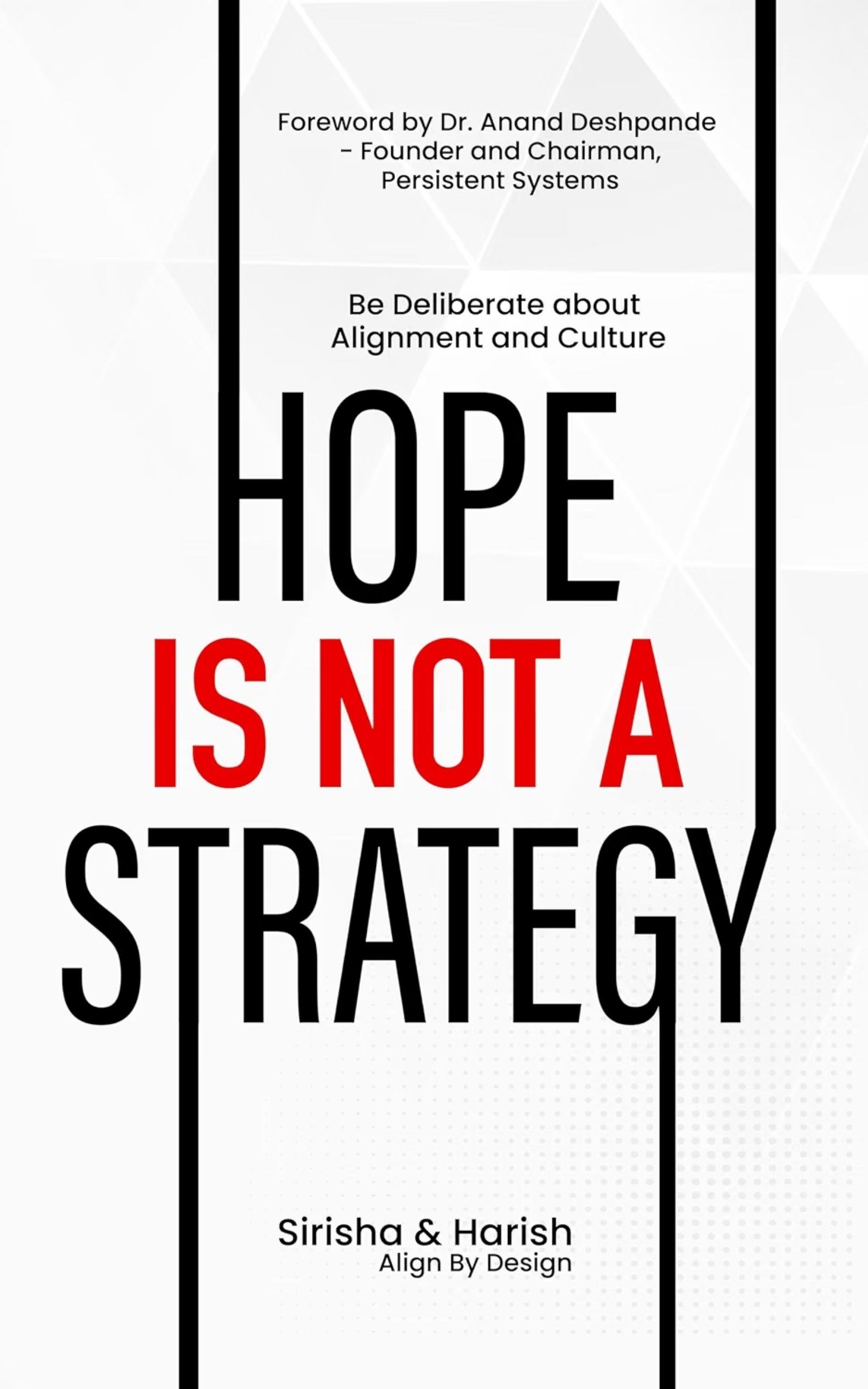
In Hope Is Not a Strategy, Sirisha and Harish, co-founders of Align By Design, explore how intentional alignment and a strong organisational culture can help companies translate their ambitions into action.
Drawing on their experience in leadership advisory, organisational development, and culture building, the authors present a practical approach to creating companies where people understand the organisation's direction and work together towards shared objectives.
Through real-world examples and step-by-step guidance, the book examines the relationship between strategy, culture, and execution. It explains why organisational values must extend beyond statements and become part of everyday decisions, leadership behaviours, and workplace practices.
Readers will discover how to strengthen strategic alignment, build a cohesive organisational culture, encourage collaboration, and create an environment where employees can contribute meaningfully to business goals.
The book also explores how leaders can approach organisational change with greater intention, develop cultures that support innovation, and establish the conditions needed for sustainable growth.
Rather than relying on hope or isolated initiatives, the authors encourage organisations to take deliberate action and build alignment into the way they operate.
Hope Is Not a Strategy is written for business leaders, founders, entrepreneurs, CEOs, senior executives, and managers seeking to strengthen organisational performance through strategic alignment.
It is also relevant to HR professionals, organisational development consultants, emerging leaders, and employees who want to contribute to positive workplace change.
Whether an organisation is establishing its foundations, navigating transformation, or preparing for its next stage of growth, this book offers practical perspectives on bringing strategy, culture, and people together to achieve shared goals.
Excerpt
From “Title Page”
Section: Step 1, Define Purpose and Desired Identity
Why does one exist, and what do they want to be known for?
Purpose and desired identity are intertwined. The purpose is the 'why' - the reason the company exists. The desired identity, on the other hand, is the 'how' - the way the company manifests its purpose in the world. Both elements deeply influence company culture. A strong purpose offers stability and a sense of meaning, while a clear desired identity aligns behaviors, shaping interactions within the company and with the broader ecosystem.
Purpose
Purpose is the 'why' that fuels an organization’s existence. It's the compass that guides every decision and action, transcending the pursuit of profits to define the difference a company aspires to make in the world. Imagine purpose as the North Star, providing unwavering direction amid the ever-shifting tides of the business landscape. Without a clear purpose, even the most successful organizations can lose their way, especially in times of growth or change.
So, why is purpose so vital? Firstly, it offers a distinct path forward. Like a lighthouse guiding ships to safety, a well-defined purpose ensures a company stays on course, even through turbulent waters. It serves as a steady anchor, grounding the organization amidst the relentless currents of competition and expansion. Furthermore, purpose kindles passion and commitment. It's the spark that ignites enthusiasm in every individual. When employees understand the greater impact of their work, they're more inclined to go beyond the call of duty. This passion extends not only to employees but also to customers and partners who share in the company's vision, forging a community of advocates.
Diving deeper into the essence of purpose, it transcends profit margins to focus on the lasting imprint a company leaves behind. For instance, an eyewear manufacturer may craft glasses, but its profound purpose could revolve around enhancing people's lives through improved vision. This profound insight can inspire innovation, propelling the company to explore new horizons beyond conventional boundaries.
A well-defined purpose serves as a powerful driver for organizational success, employee satisfaction, and societal impact. Some key advantages of a well-defined purpose statement include:
Clear Direction: A defined purpose acts as a compass, providing a clear sense of direction for the organization. It helps leaders make informed decisions and set strategic priorities that align with the company's ultimate goal.
Inspired Workforce: A compelling purpose inspires and motivates employees. When individuals understand how their work contributes to a larger mission, they are more engaged, passionate, and committed to their roles.
Trailer
Published by Stardom Books — written from the author’s own words, in the author’s name. Browse the catalogue
Start here
The Authority Quotient is a thirty-minute evaluation that measures your authority two ways — how you rate yourself, and what a stranger can verify — and ends with one specific recommendation, including which type of book is yours.
Find your Authority QuotientNo cost. Get detailed report. Includes specific recommendations.