Where to buy
Carried by Amazon in every market, Barnes & Noble, Walmart, Waterstones, Booktopia, Kinokuniya, Flipkart, Google Books, Apple Books and Kobo. Printed on demand close to wherever it is ordered.
Listed with the worldwide trade network, so any bookstore or library can order it. Ask for it by ISBN: 978-1733211680 (paperback).
What is inside
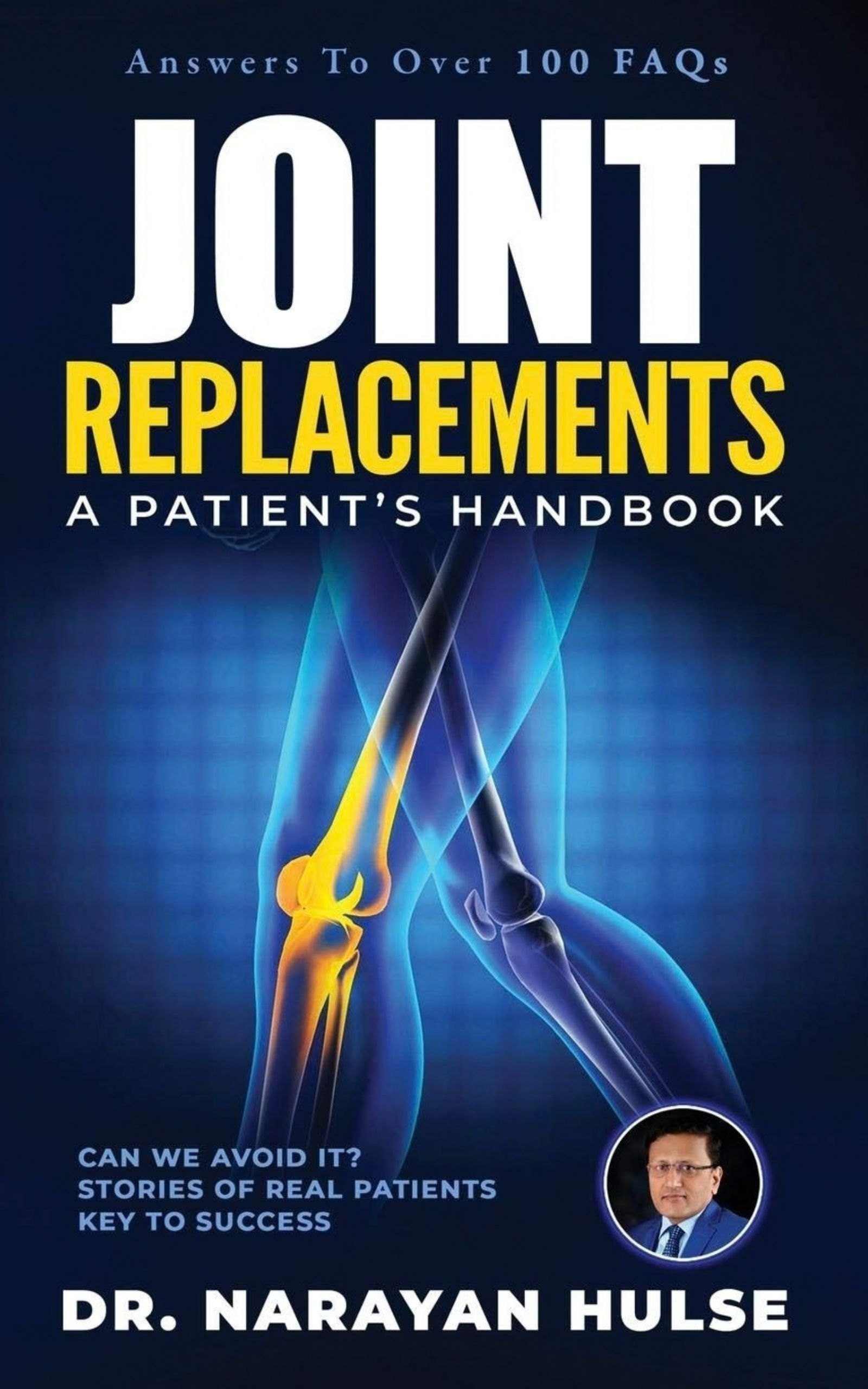
Joint Replacements: A Patient’s Handbook by Dr. Narayan Hulse is designed to help patients understand joint disease, treatment choices, and the realities of joint replacement surgery. Drawing on more than two decades of clinical experience, the book brings together questions commonly asked by patients and addresses the concerns that often arise before, during, and after treatment.
The book discusses arthritis, the different ways joint problems may affect mobility and quality of life, and the situations in which joint replacement may become necessary. It also examines common myths and misconceptions surrounding surgery, including the confusion created by unproven or inappropriate treatment approaches.
A major focus of the book is patient education. Dr. Hulse explains why some forms of arthritis may be managed with conservative support, while advanced joint disease may require surgical intervention. The book also looks at preventive strategies, treatment options, possible complications, and the importance of making decisions based on a clear understanding of the condition.Structured around more than a hundred frequently asked questions, the book aims to make joint replacement easier to understand and less intimidating for patients and families.
This book is for people living with arthritis, chronic joint pain, deformity, or reduced mobility who want to understand their treatment options more clearly.
It is also useful for patients considering joint replacement surgery, family members supporting them, and readers who want a practical, patient-focused introduction to arthritis, surgery, recovery, and informed decision-making.
Excerpt
From “Title Page”
Joints where two bones come in contact to provide mobility, have a soft lining called cartilage. This structure is damaged progressively in all types of arthritis. Unfortunately, cartilages have no intrinsic healing capacity, and there are no effective medicines to regenerate them.
Joints are the locations within our body where two or more bones meet. Most of the joints provide a variable amount of mobility to allow a certain degree of movement, as required to function effectively.
Bones provide stability and a framework like a scaffolding for other organs of the body. For example, our shoulder joint has more mobility as it enables us to perform finer activities; however, they are not very stable; they easily dislocate. On the other hand, although our knee joint has only unidirectional movement, they are strong, and they rarely dislocate. Knee joints have to be strong as they have to carry our body weight.
Structure of a Joint
As I mentioned earlier, a typical joint involves two bones meeting each other (figure 1). The presence of cartilage, a resilient, smooth elastic rubber-like tissue, protects the bone's end surface in the joint and prevents them from rubbing against each other. Put simply, it acts as a cushion and reduces the friction between the bones. The cartilage is progressively damaged in all types of arthritis, resulting in increased friction and pain.
1 INTRODUCTION
One of the key prerequisites for a successful joint replacement surgery is a well-informed patient. Every time I come across a new patient, I am met with a new question that has never been asked by any of my previous patients, and this, I believe without a shadow of a doubt, has added more value to my experience spanning over two decades as a Joint Replacement Surgeon.
Having witnessed an array of clinical interactions with patients suffering from joint pain, I have many clinical encounters to share, and this book has paved the way for me. I have attempted to consolidate my experiences to help the readers understand, decide, and recover from a joint replacement surgery successfully.
Myths
Several medical myths scream for attention; while some are harmless, many are downright dangerous. This may be due to the lack of public awareness or even the fear associated with surgery. These myths result in many patients undergoing different forms of alternative therapies like Ayurveda, homeopathy, magnetotherapy, electrotherapy, and several other remedies, which are not curative.
About the author

Senior Director Orthopaedics, Fortis Hospitals · Bangalore, India
Dr. Narayan Hulse is a senior joint replacement surgeon and Director of Orthopaedic Surgery at Fortis Hospital, Bengaluru. He specialises in joint replacement, arthroscopy, pelvic-acetabular trauma, surgical training, and research.
Published by Stardom Books — written from the author’s own words, in the author’s name. Browse the catalogue
Start here
The Authority Quotient is a thirty-minute evaluation that measures your authority two ways — how you rate yourself, and what a stranger can verify — and ends with one specific recommendation, including which type of book is yours.
Find your Authority QuotientNo cost. Get detailed report. Includes specific recommendations.